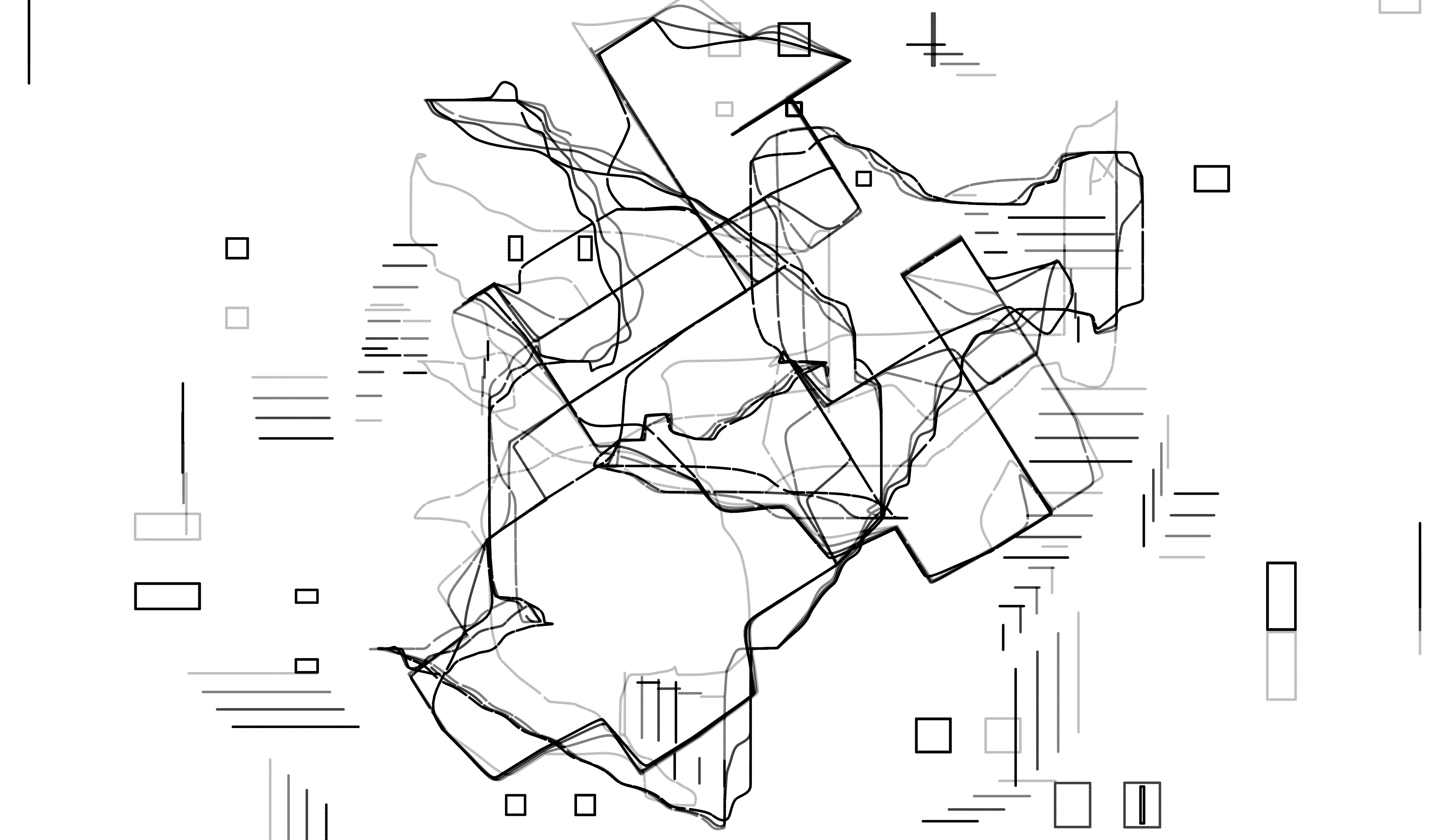
Working on a project like FIRST LIGHT for such a long time — depending on perspective, for two years or more — comes with its very own challenges. At the beginning, there was an idea and the need to build a lot of technology to turn it into reality. I spent most of the time writing my laser software. And by doing so, I defined how my new project should operate on a structural level. I needed to answer questions about what constitutes a piece, how to move from one part to another, and what kind of general visual aesthetic I wanted. I tried things out, observed the results, and changed the code until results were promising. There was not yet an overall shape, just a collection of visual sketches.
In parallel, I spent time in the studio recording sounds and filling up my ever-growing library — not with any final goal, just with the desire to have a lot of new things to play with. Later I started to make musical miniatures using these sounds. When I could not focus on writing code anymore, I made music. When I felt clear and energetic, I worked on software. Occasionally I played my musical miniatures when testing my graphics code. Sometimes a resonance happened: the music and the moving image talked to each other. In an evolutionary process, things slowly grew together.
A few months ago, I started to make up my mind about the overall structure, arranging my bits and pieces in time, using stickers on a wall. Which order makes sense? Which element to introduce when? How to start? How to end?
The order changed multiple times. The music for some of the visual pieces also changed several times. I was confident about a lot of the individual elements, but worried about one thing that matters a lot to me: The overall flow of time. I have been to concerts where I lost interest in the music halfway through because the order felt arbitrary; there was no sense of drama, no 'inevitable' progression towards an end. I was afraid FIRST LIGHT might fall into the same category.
It does not. A few days ago, I worked on the ending, structuring the last five minutes visually and sonically. And something magical did happen: I was touched by it. I was touched by how I felt when playing it: It is good the way it is! It ends exactly how it should end, and it gives everything closure. A week earlier, I was much less confident. The last twenty minutes still did not come together. The last four pieces did not produce that desirable sensation of natural progression towards a finale.
From experience, I knew that the logical thing to do is to remove material, finding the elements that inhibit the flow. Perhaps one of the pieces has to go? But I liked the visual parts of all of them, and I liked some elements within the music. What to do? I thought about merging the two musical pieces into a new single one, without much hope that it would work. I tried it, and the stars aligned. It was surprisingly easy and fruitful. Adapting the laser graphics was equally straightforward. And suddenly the biggest obstacle was gone.
I often wonder how much control over the process I actually have. I did not plan FIRST LIGHT to become what it is now. It became a 75-minute-long, very composed, very cinematic, experimental, abstract film-electronic-music-concert thing, constructed of twelve individual parts.
It could have become something very different. In fact, two years ago I aimed at building a much simpler, more improvised and less composed scenario. I don't feel I made the decision to turn it into something else; it just emerged whilst working on it.
This is what I like so much about my work: it guides me, it teaches me, it makes unexpected turns. A while ago, I built a small controller box for FIRST LIGHT. I wrote about it here. It was made at a stage of the project where I expected it to be performed in a quite different way. Now I have to rethink how I am going to use it, and I have to write new software for it to fulfil my new requirements. Another little task in the next three weeks.
I still need to finish the structure of one last musical piece before I can align the laser graphics. This should be done in a few days. The rest of the time till the premiere is reserved for refining things where needed.
What I might have to sacrifice is the multichannel / surround sound aspect. I want to have something ready for the premiere, but I don't think I can explore it in-depth. This has to wait for another 'update' later. But apart from that detail, I am almost there and slowly beginning to feel a sense of real achievement.
Several small web updates since my last post: Some new photos here, and a new tech page here.
Last week I had the pleasure of seeing Tristan Perich's 'Infinity Gradient' here in Berlin, and it blew my mind. If you have a chance to experience it — do it. The recording does not do it justice: the spatial aspect of the work, delivered by the organ and 100 loudspeakers, can only be experienced live.
This is also why I never released my performance Dust. It is an improvised multichannel audio piece where a lot of the effect comes from the spatial distribution of similar signals. Folding it down to stereo does not come close to providing the same effect. I tried several times in the past to turn the material into a CD, and gave up each time. If you are in Berlin, there is a chance to witness 'the real thing': I am going to play it at Berghain as a six-channel version, as part of Sound Metaphors Festival, on October 30th. Find the link on my main page.
I have been thinking a lot about the performance practice of computer-generated music. I wrote about it here. Before FIRST LIGHT became what it is now, I just wanted to create a new AV performance work. I wanted to construct something that can be shown all around the world (unlike CBM 8032 AV, which requires transport of the old computers in a van) and that could work in multiple contexts. I wanted to work again with lasers because I spent a lot of time in 2022 building new laser pattern software for a project that ultimately did not happen for reasons beyond my control. There were so many ideas in that one which deserved to be explored in more depth.
My initial idea was based on having three screens on stage, with lasers projecting onto those screens from the front and back. I got quite far conceptually, but essential questions remained unsolved, especially how to scale the work for various venues, how to adapt it to work with a standing and seated audience, what is the relationship between the projection on the screens and the laser beams in space and such.
Sometimes — often, most of the time? — external events help make a decision:
When I began to work on FIRST LIGHT, I did not intend to perform my older laser piece Lumière anymore. But I got a request from Mapping Festival in Geneva, and that required me to familiarise myself with the piece again. When I was rehearsing and finally playing it again, two things became clear to me: one big projection is enough, and it is powerful; I do not need this complex setup with three screens. And I need to also perform the new work in the middle of the audience. That epiphany set the path, 18 months ago. And now we are close to the premiere!
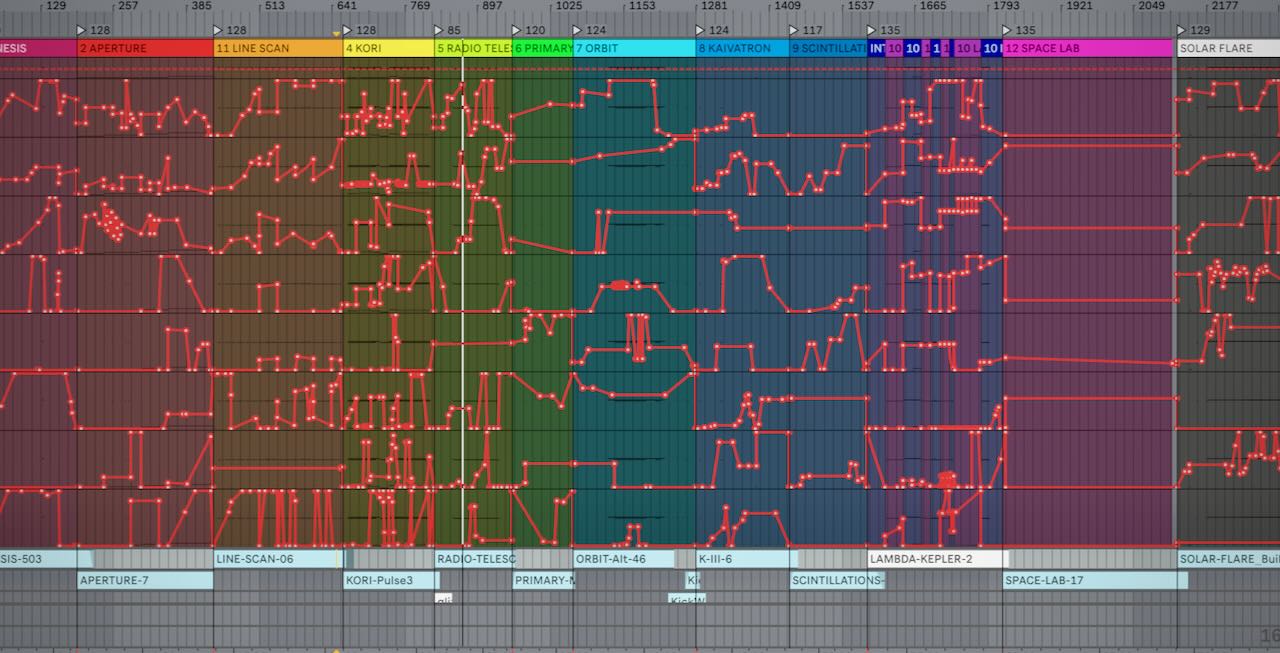
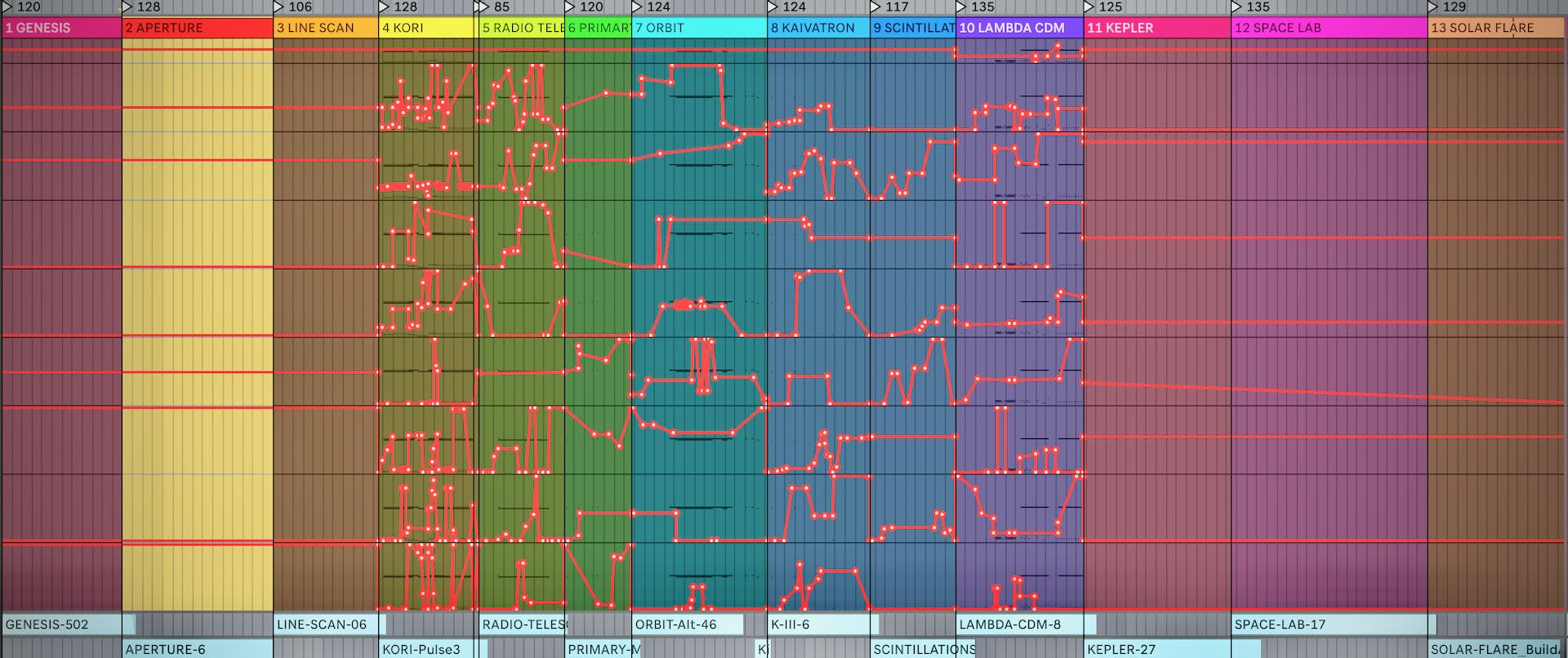
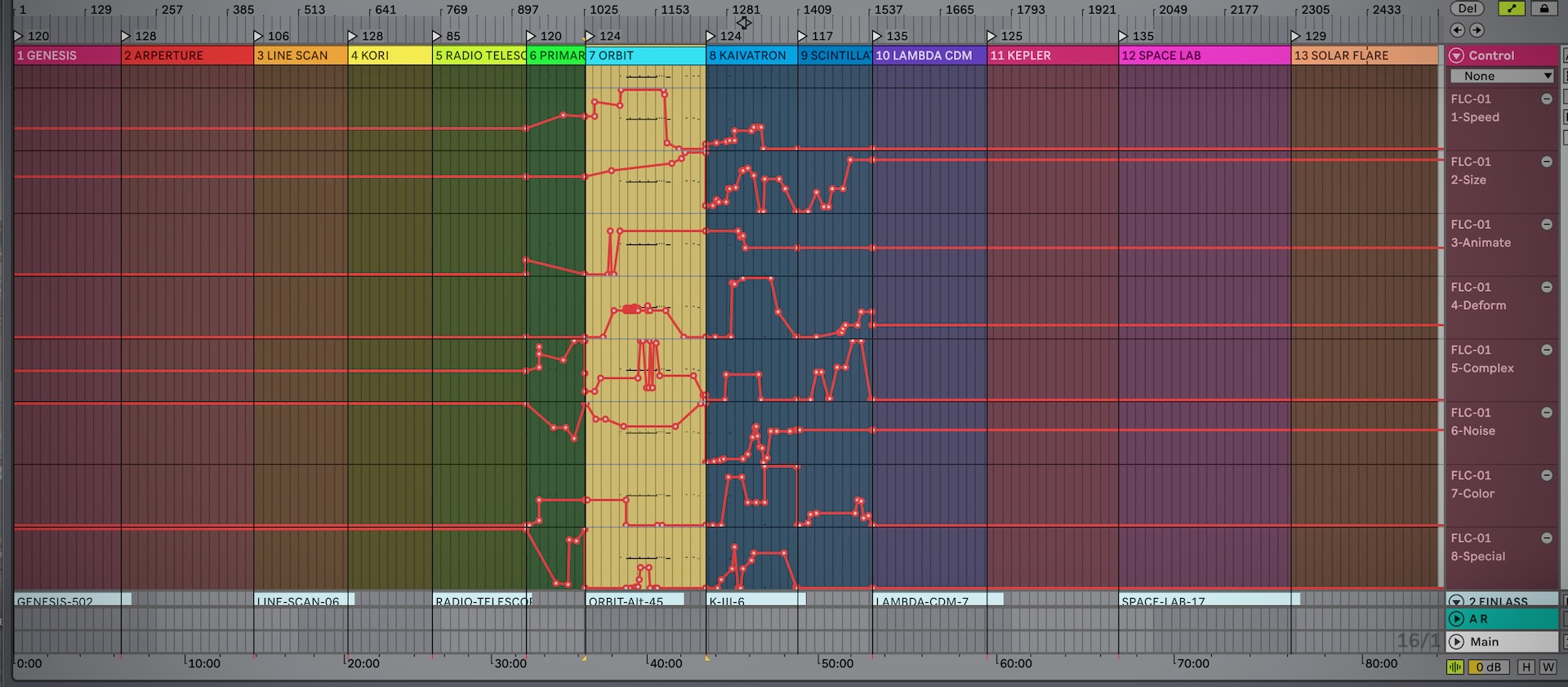
I am working on FIRST LIGHT every day, with the usual mental ups and downs. Compare the screenshot above with the one from the previous blog entry... Sometimes I believe it is going to be great; other times I think it is boring and arbitrary. But at least this is a mental pattern I became quite used to before finishing big things. Ultimately everything is always work in progress, and if there was a motivation to start a new work, the best thing to do is to trust that initial impulse.
The other essential experience — which a lot of other artist friends seem to agree with — is the fact that different people tend to like (or dislike!) artistic works for entirely different reasons than expected. In every artistic practice there are parts that are easy to do for the artist, and others that require a lot of work. Naturally, the artist has a tendency to downplay the significance of the easy parts and to place emphasis on the challenging ones.
However, for the audience this is often completely irrelevant. They might especially like aspects of a work that the creator might not even realise as being of value, because it feels so natural when doing it. They might react most enthusiastically to the parts which were made with the least effort.
But to find those golden moments where something quickly emerges out of a simple pattern, the exploration of more complex ideas is also necessary. There is no shortcut. Elegant simplicity is often the result of removing all the ornamental parts that lead to nothing. But there has to be ornament first. Bottom line: It remains complicated and challenging. It is a lot of work, and that's why it is satisfying to do. Eat this, prompt music creators!
Currently I share my flat with a very agile and incredibly fast-moving mouse. Although it is really cute, I am not entirely amused, especially given that I disagree with the idea of using the empty space behind my router/NAS as a toilet. I am afraid this requires a solution. Can't have mouse on NAS here.
I use Claude to turn my unstyled blog texts into HTML and to add them to my blog page. Claude comes up with the titles. I would have chosen a different one, but strange AI things are the contemporary equivalent to the mp3 image artefacts of the past. If that's the biggest problem we are facing concerning AI there is no need to be worried.
Five weeks to go till the premiere of FIRST LIGHT. Image above shows all the pieces, arranged in time. Each piece has been created individually, and each piece has a matching visual counterpart. The visual side is a script inside my laser engine, defining what the lasers should draw. The link between the music and the lasers is done via sending MIDI notes and automation data.
In the next weeks, for each piece I am going to work on the integration and sync between sound and light. This is not a one-way street, it might well be that the emerging visual patterns suggest edits in the music: some elements I might want to have longer, others could be cleaned up, and so on. This is the part where things really become alive.
Ideally, all this is perfectly done in three weeks and the remaining time can be used to transform that static scenario into a structure that can be performed with more freedom. At the moment I do have a lot of control over size, color, and speed of movement of objects, and I have control over a lot of things related to timbre in the music, but the overall flow in time is fixed. I aim for a bit more flexibility here, simply because it is more challenging and more fun to play, and gives room for more happy accidents, too. However, it does not look like this is going to happen for the premiere. But I hope this work is touring for a few years and there is an incentive to update and refine it over time.
What I also still hope to accomplish is to turn the current stereo version into a full surround sound setup. This might also take at least a week, and I am not sure it can happen before November 7th, but I am still aiming for it.
Listening to all the pieces in sequence, and looking at the visual side still gives me confidence that the order is solid, and there is a sense of a bigger narrative. I hope it can be interesting to experience and that it will be perceived as meaningful and not just as a random collection of parts. Currently the length of it is 82 minutes, which is a lot, and this also implies that I could still remove one piece if I find it very much not fitting anymore, or that I can shorten things where necessary.
In three weeks I am going to show the work to a few friends in a private preview event. I have done this for CBM 8032 AV seven years ago, and it was quite helpful. It is a good way to get external feedback and to get a feeling for how others, who see and hear it for the first time, experience it.
One might assume that creating something of that scale is a process where a deliberate idea stands at the beginning and everything that follows is a logical progression. In some ways this is true, mostly in the software development part for the laser engine. But ideas quickly develop their own life. I made a lot of musical sketches in the past two years, I tried out a lot of graphics routines, and some experiments were more successful than others, which then guided my next steps. Did I plan that the music turned out the way it is? No. Did I plan that the shapes and colors and movements behave like they do? No. I just allowed it all to happen, and I allowed these ideas to grow. Now all I can hope for is that my intuition did not completely fool me, and that the result makes sense to the outside world, too.
To be honest, I am 95% convinced it will be the case. Five more weeks to go.
Addendum: people are indeed reading this. A certain Oliver S. pointed out that in the screenshot, the track title 'Aperture' is spelled wrong. Thank you, Oliver, it is fixed now, but I am not going to make a new screenshot.
I'm working on all kinds of things at the same time: designing a leaflet for the premiere, writing emails to promoters, making changes to the musical side, making changes to the visual side, and so on. The good news: it still mostly makes sense.
I just added a teaser video, shot recently in my workspace in Berlin, that gives a bit of an idea about FIRST LIGHT. You can find it on the index page. I am always a bit hesitant to share work in progress, since it is usually still far away from a final result — but hey, marketing! So, here we go. Hope you like it.
The last few days I was pretty knocked out by a cold and could not work on anything software-related — my brain was too foggy for that. What I could do, though, was spend time in bed with my laptop and make edits to the music.
Since we are now less than six weeks away from the premiere, I am shifting my focus away from individual pieces of music or visual sequences and instead looking at the overall flow. And in doing so, I came across a part that I really did not like anymore, especially sonically. I was tempted to remove it entirely, but I liked the laser graphics too much — there just needed to be a different musical layer. I became mildly grumpy because it was such an obvious flaw in the composition, and I did not feel I could easily fix it. However, giving up is not an option, so I hacked together some sounds until a somewhat interesting color and rhythm appeared. But the overall mood became quite sinister and dark musically, and I was not sure that was the emotion I wanted in that segment. I tried several versions but got the impression I was running in circles. I gave up.
Now, one thing I have learned over the course of my career is that when I get stuck with something, it is a good idea to do something different and perhaps come back later. I was in a music-making mood, but I was not successful with creating that new piece. Instead, I decided to leave the computer screen and spend some time with a few older synthesizers and hardware effects.
Since some of the instruments I really enjoy are way beyond their intended lifespan, I have this ritual of turning each of them on once in a while just to verify they still work. I am happy to report that my small Synclavier II still boots and does what it is supposed to do. However, nothing came out yesterday that inspired me.
Instead, I turned on my Oberheim Xpander — certainly an instrument that is far from being my favourite. You might ask why I have it if I do not like it. The answer is a bit complex. It is a very unique instrument from 1984, a digitally controlled, almost modular analog synthesizer without a keyboard — hence the name. It was intended to be played via another keyboard or a computer. Everyone who could afford it had one in the 1980s; it was one of the must-have items for electronic and pop music production.
The Xpander and I never really became friends. I bought it used some twenty years ago for almost nothing, and I kept it because it is technically amazing — it really is an engineering masterpiece — and it looks extremely cool. The sound never really resonated with me over the years.
However, I occasionally play with it, because despite my not liking it, I somehow do like it. I guess if we were in a relationship, the status would be "it's complicated."
I had my I-got-stuck piece of music running from my laptop, only the rhythmical parts, and I started to create a new sound from scratch using the Xpander, just to see where it would lead me.
And it is often in those almost non-intentional moments that essential things emerge.
Suddenly I had a sound whose textural quality reminded me of a lot of music from the 1980s that I really like, and I realised that all those sounds were probably made with it back then. And in a most unlikely juxtaposition, that kind of texture turned out to be the missing element in the piece of music I had failed to finish.
In a dramatic movie, this is the moment when the genius composer writes notes in a frenzy and the symphony is done. In my case, I just enjoyed what came out, and for some reason (yeah, I am a genius!), I did press record in my DAW and captured thirty minutes of beautiful harmonic textures. And then my cold came back and I went to bed.
Only this morning did I realise that my piece is complete, and that all the elements are there now.
I feel less and less comfortable on social media, for numerous reasons, which I might discuss later if I have a really bad day. This is an attempt to bring some of my activities back to my own webspace, outside a monstrous Silicon Valley tech-bro controlled framework that monetises conflict and actively encourages and nurtures the lowest instincts in people. I intend to write here — hosted and controlled entirely by myself — about works in progress, about my little victories, and maybe even sometimes about my doubts (which people rarely do on social media anymore, understandably of course), and provide lots of background info about my artistic practice. Or pretty much anything I find worth sharing. We will see where this ends. Hope you get something out of it. Feedback always welcome.
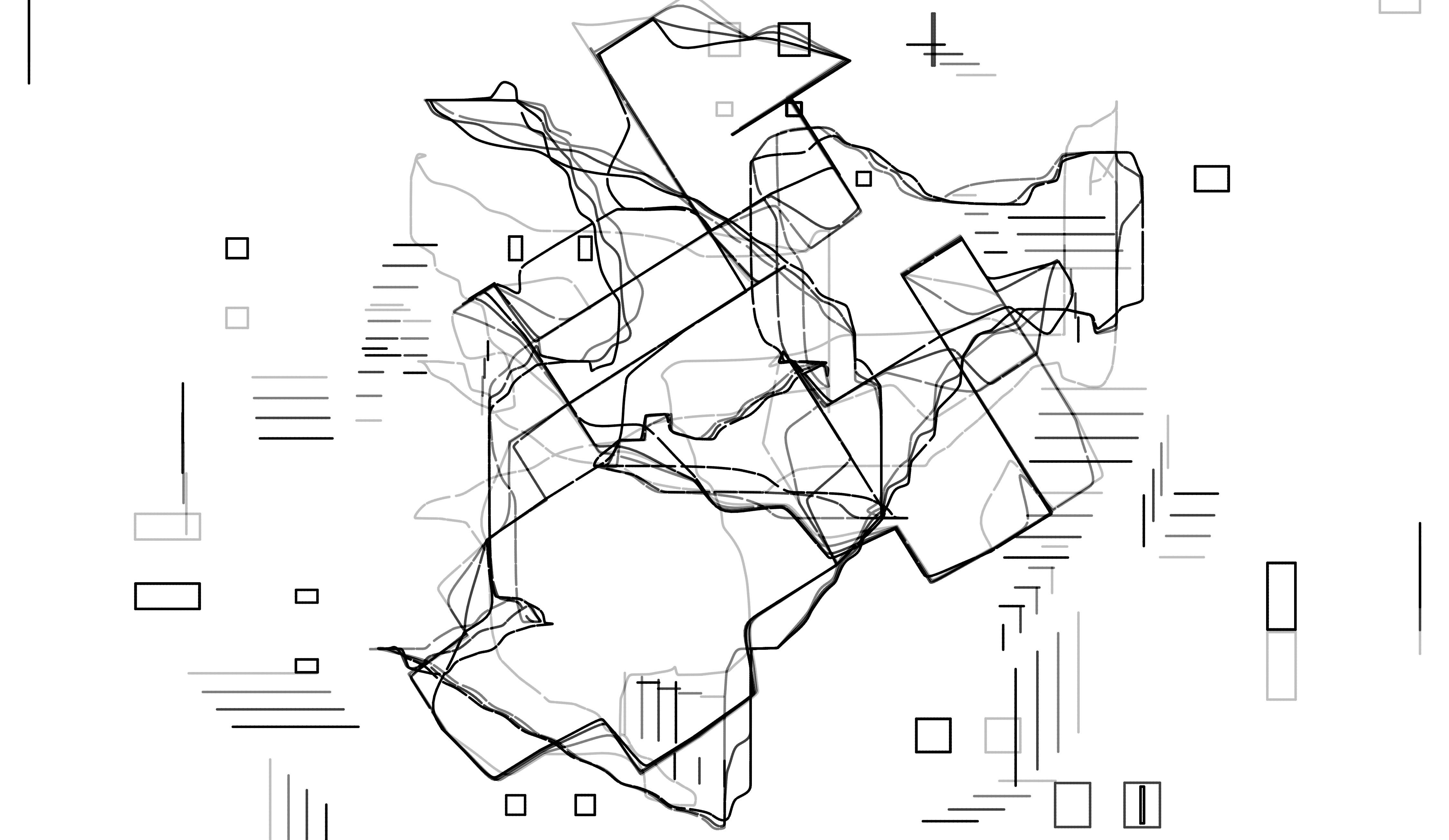
The image on top shows laser graphics from my upcoming FIRST LIGHT performance, captured directly inside my own laser control app and afterwards using a vibe-coded web app to render the result as inverted black/white images. The result is very close to what the lasers are actually drawing but it also adds that little layer of abstraction to it that makes it interesting in its own way. I intend to use it to generate images for a planned program note leaflet for the premiere.