FIRST LIGHT
audiovisual performance [2026]
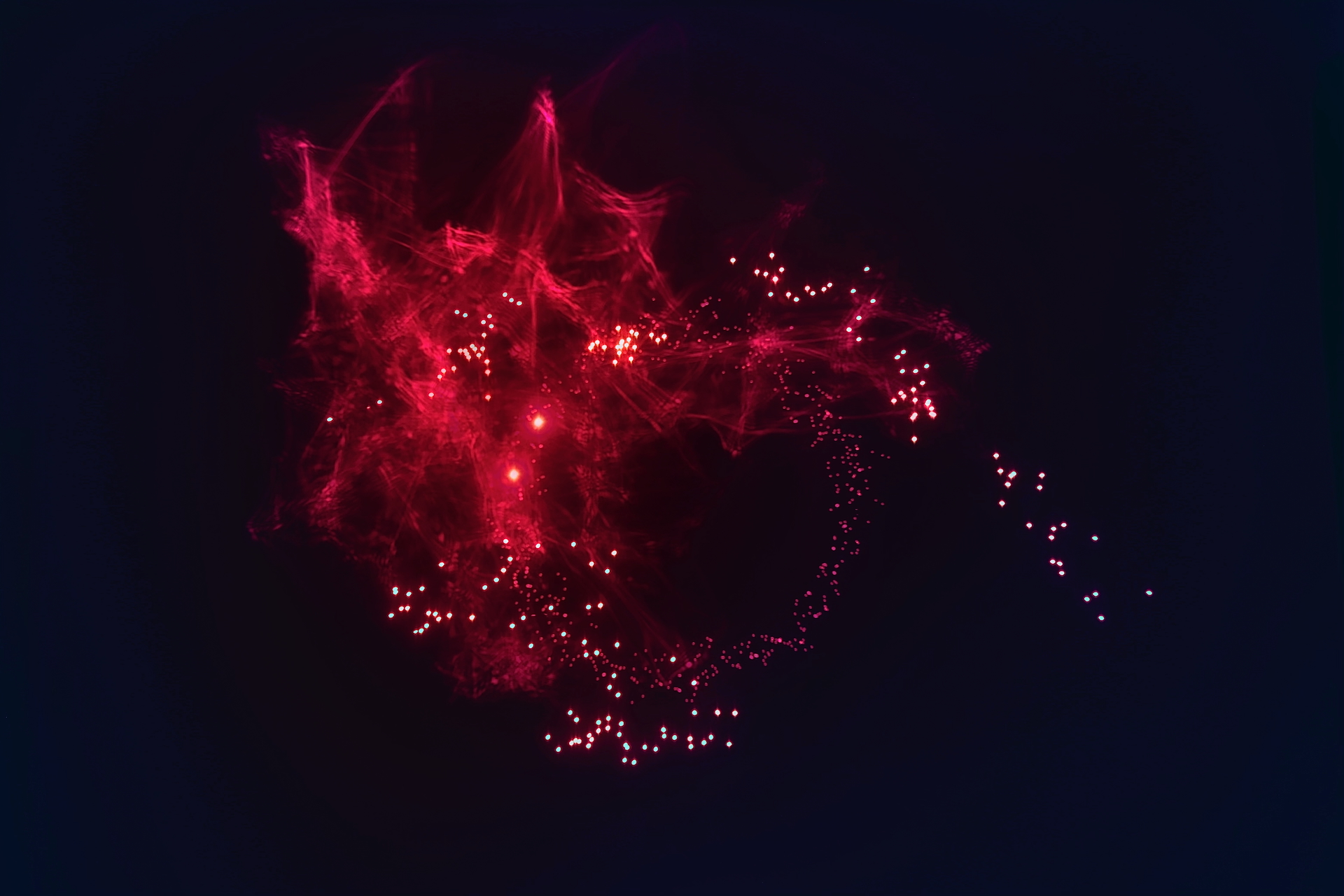
FIRST LIGHT is an audiovisual performance, commissioned by the Barbican Centre, London. Its creator is controlling the machinery from within the audience, part facilitator, part observer. World première at the Barbican Concert Hall on November 7th 2026.
In astronomy, first light marks the moment a newly built optical instrument, such as a large telescope, opens its eye to the cosmos for the very first time.
It captures an image of a real celestial body, often a distant star or galaxy, signalling the start of its operational life. Though the instrument is not yet tuned to perfection, this is when the full system operates together for the first time, its parts aligned and awakened, ready to be evaluated by the humans around it.
The moment is rich with anticipation, the culmination of years, sometimes even decades, of vision, labour, and perseverance
First light is more than a test; it is a promise, a glimpse of the wonders to come, and hopefully a confirmation that the effort was not in vain.
What follows is a slow and deliberate unfolding: the refining, the calibrating, the long dialogue between the instrument and its creators.
In time, its true potential emerges – often revealing more than its makers ever imagined, reaching farther than they had dared to hope.
The Artist is Present
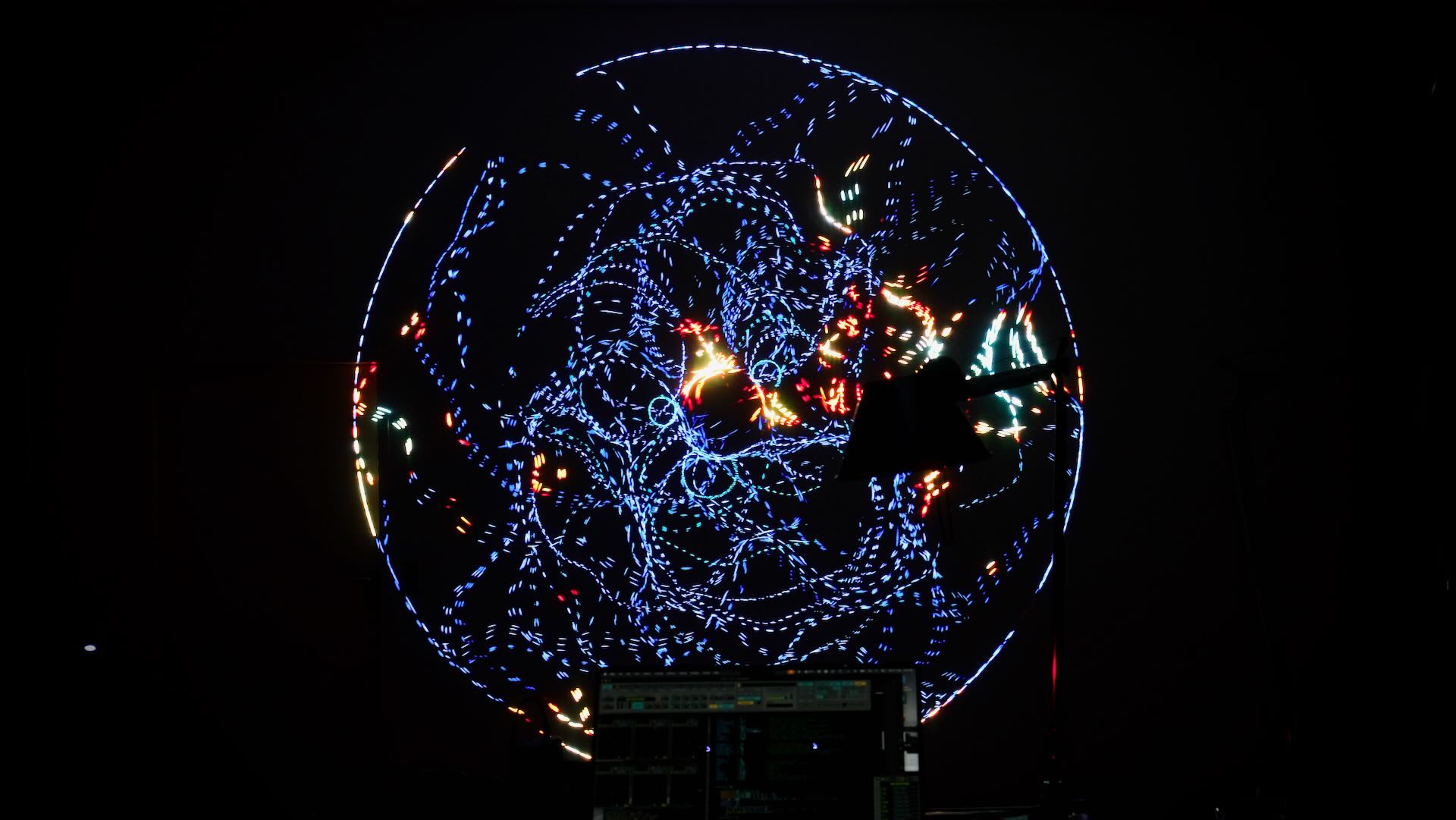
For FIRST LIGHT, no one is present on stage.
It is a deliberate decision against the artist being the main visual focus. It is not about a person, but about a creation – the artist's personality is reflected through it, via the interaction with the work itself and with the audience during the performance. The artist is present.
Perhaps even more so, since there is no physical separation: the creator is not elevated, not removed, not fenced away.
Instead, the artist conducts, shapes, and drives the work from within the room. The perspective on sound and image matches that of the audience, allowing for a more detailed and informed interaction with the creation – and potentially a greater ability to "read the room" and respond to it.
FIRST LIGHT is not the first work I have performed in this manner. I explored this practice in my Lumière concert series, in my multichannel listening piece Dust, and in selected Monolake Live Surround performances.
My motivation has always been twofold: I enjoy being able to experience the work "as it is intended" – not through stage monitors and displays.
But equally important is the cultural subtext: early club culture in the late 1980s and 1990s deliberately broke with the separation of audience and performer, and with the elevation of the latter, both metaphorically and physically. I still find this model deeply appealing.

Art and Science
At first, FIRST LIGHT did not have a title. It was just a vision of how to combine sound and laser graphics into a new audiovisual performance: fragmentary ideas revolving around shapes I wanted to draw and sounds I wanted to arrange in a meaningful dialogue.
Then I stumbled across the term "first light" as it is used in astronomy, and it immediately became clear that this had to be the conceptual cornerstone of the new work. It fits my way of thinking about process: the combination of precision and predictability with uncertainty and curiosity about results yet to be seen.
Part of my artistic practice is reading, and being inspired by things beyond writing software and processing audio files. This made me think again about a topic I have always found worth exploring: the relationship between art and science.
The Scientific Revolution of the 16th and 17th centuries, led by figures like Galileo Galilei, Johannes Kepler, and Isaac Newton, brought a new way of understanding the world: one grounded in logic, method, and verifiable truth. Yet the fruitful Renaissance idea of combining art and science remained. Artists studied anatomy, perspective, and optics; scientists often practised drawing and design.
For a time, artistic exploration and scientific inquiry were not seen as opposites, but as complementary ways to engage with the mysteries of existence. Discovery was both rational and creative.
But by the 18th century, and even more so with the Industrial Revolution, this unity began to fracture. Universities and academies drew hard lines between "science" and "art", separating the pursuit of knowledge from the pursuit of beauty.
Science and engineering became tied to industry and progress, valued for their practicality.
Art, meanwhile, was increasingly dismissed as decorative, emotional, impractical – something apart from the "serious" work of understanding the world.
This division was reinforced by the ideology of "separate spheres", which linked men to the rational, public realms of science and business, and women to the emotional, private domains of art and domestic life. The history of science tells its own story here.
Lise Meitner provided the physical explanation for Otto Hahn's experiments on nuclear fission, yet the Nobel Prize went to Hahn alone. Jocelyn Bell Burnell discovered pulsars as a doctoral student; the Nobel Prize went to her supervisor.
Curiosity
These stereotypes still shape our thinking today. Our education system tells some kids they're more of "the artistic (or social) type", steering them away from science, technology, engineering, and mathematics, while others are told they lack "the artist gene". As if creativity and logic were mutually exclusive. What a tragic waste of potential on both sides.
In reality, science is about seeing the world from new angles, following intuition, and challenging assumptions – processes any artist would recognise. Good engineering is about finding elegant, even beautiful, solutions to complex problems, designing interfaces and objects that feel intuitive and effortless.
At their core, both art and science are driven by curiosity, experimentation, and the courage to ask: What if…?
Yet the myth persists: artists are irrational geniuses, struck by divine inspiration, while scientists and engineers are cold, hyper-rational problem-solvers. This false divide ignores the rigorous methodology behind artistic practice – the deep understanding of materials, the physics of light and sound, the mathematics of form – and the creativity at the heart of scientific discovery.
How much more attention would I have paid to maths at school if I had had any idea that I would be wrestling with it so much half a century later in my artistic practice!
This is deeply personal for me. Coming from a family of engineers, I found my way into the arts through sound engineering and software development. I've experienced first-hand how education fails to show students that scientific methodology and artistic expression are not opposites, but two sides of the same coin.
My art would not exist without advanced technologies. And those technologies would not exist without the inspiration, craft, and artistic mindset required to envision them in the first place.
When I began developing FIRST LIGHT, I immersed myself in astronomy and astrophysics, and I once again observed an all-too-common pattern: so much of our understanding of the universe has been shaped by women. Women who analysed data, developed theories, and spotted the anomalies that changed everything – yet were rarely credited, rarely remembered.
This work is dedicated to them.
Robert Henke, Berlin, Spring 2026
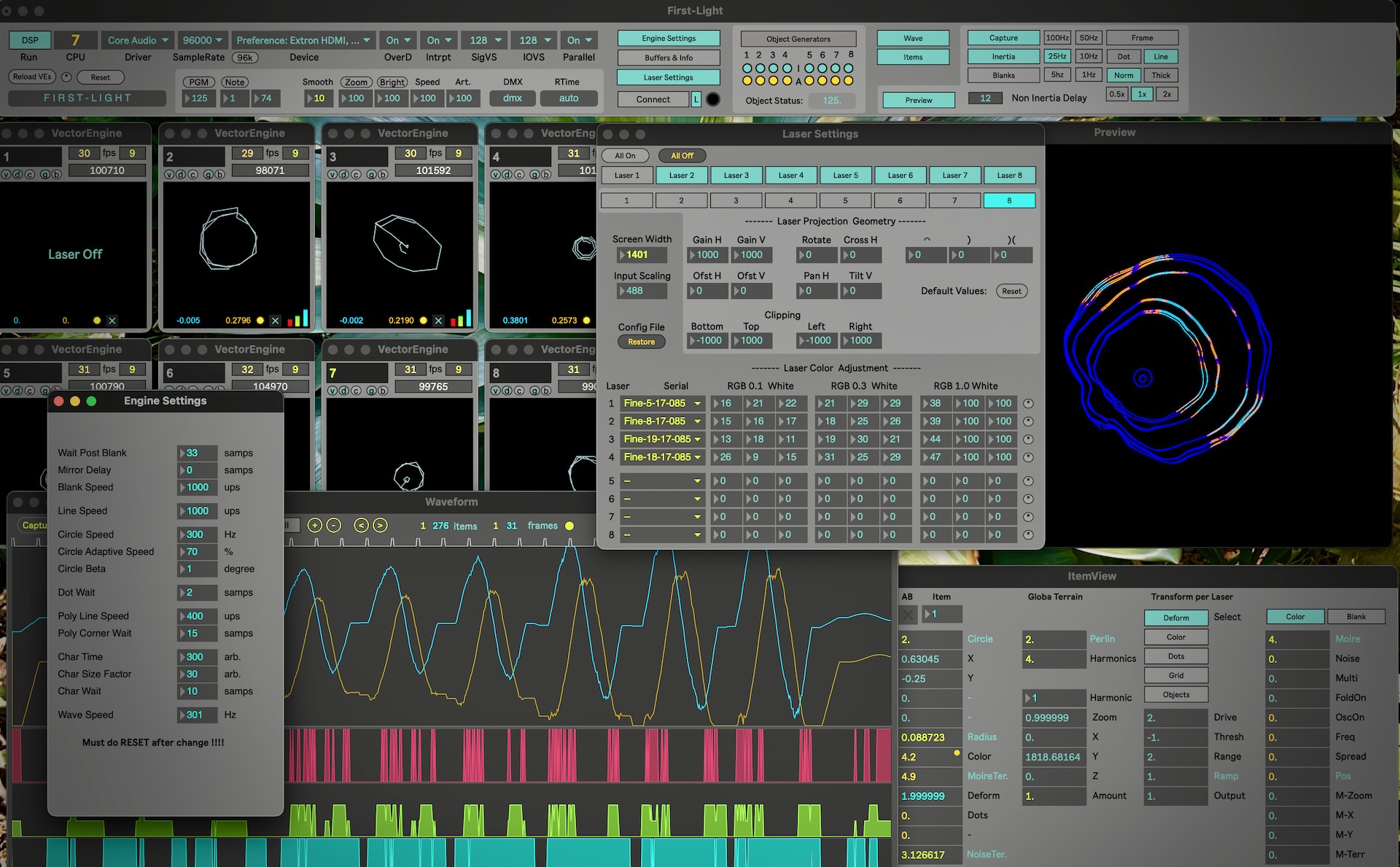
FirstLightEngine, screenshot
Credits
Robert Henke: composition, sound design, performance, FirstLightEngine development, laser graphics programming.
Jonas Margraf: additional laser graphics programming, general and coding magic, donut delivery.
Laser projectors and kind support by LaserAnimation Sollinger Berlin. Thank you Michael Sollinger for your friendship, dedication, and visionary engineering skills.
FirstLightEngine is a laser graphics software developed since 2020 by Robert Henke, based on MaxMSP. Thank you Joshua Kit Clayton @Cycling74 for bug hunting and fixing at the speed of light.