Astronomy
Robert Henke in discussion with Timothy Fellsrow
The following conversation between Robert Henke and Timothy Fellsrow took place during several evenings in Summer 2026, on Robert's balcony. Timothy and Robert enjoyed a lot of good tea, sometimes a glass of wine, and talked about the world, politics, and FIRST LIGHT. The text below is the essence of these discussions.
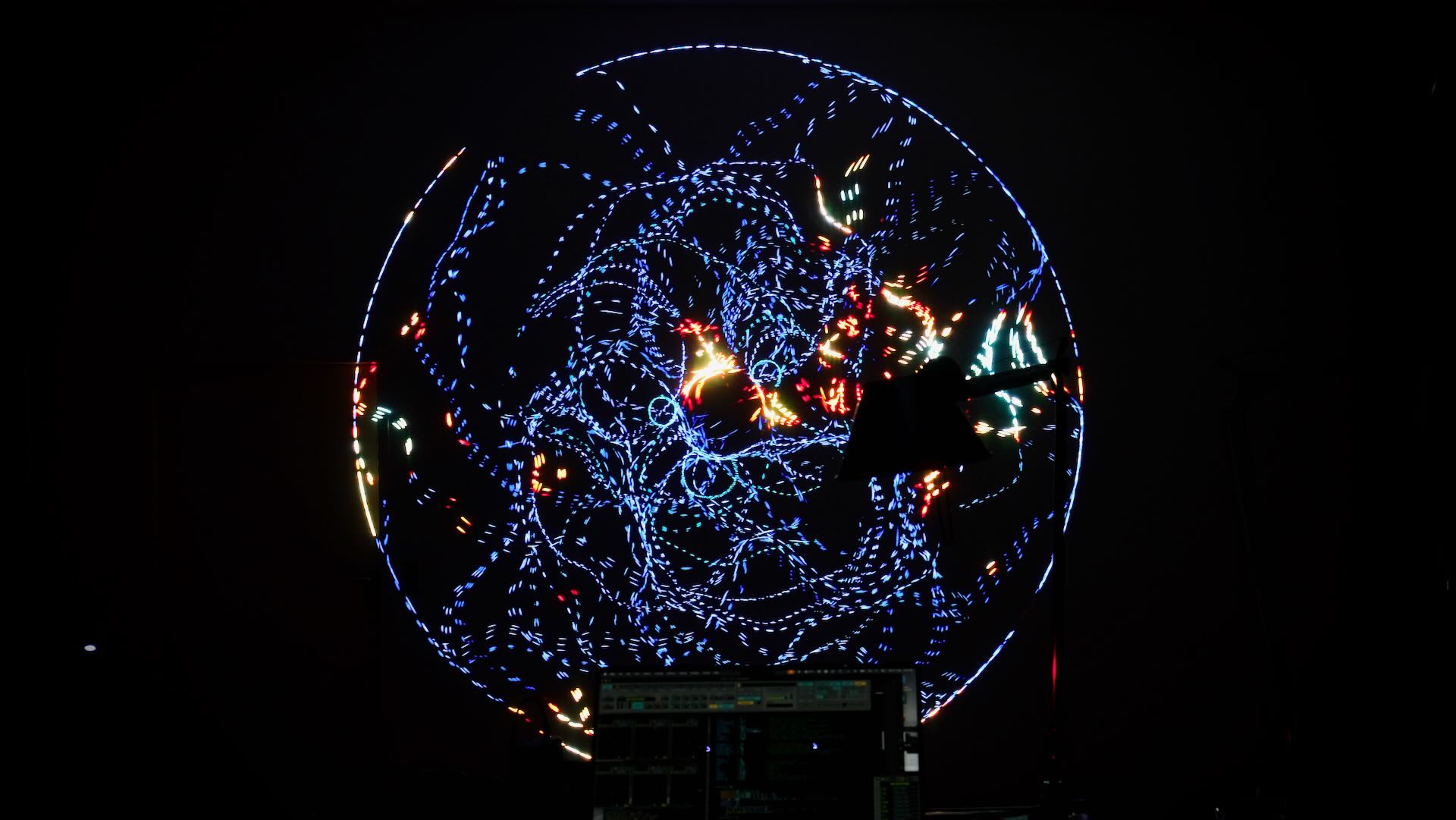 [rehearsal, September 2026]
Who are you?
TF: On your website you define yourself as 'artistic toolmaker'. You build a lot of the machines you work with by yourself, including - to a certain extent, Ableton Live, isn't this already enough? My provocative question here: Why do you 'also' make music and produce audiovisual art?
RH: This question did bother me for a long time. I was never sure if I could call myself 'artist', because I do spend so much time with engineering. But I finally came to the conclusion that both occupations are the same: I create!
That includes music, visual works, concerts, recordings, and also code, hardware, tools. Somehow all this evokes similar emotional responses: I am happy if something works, I am anxious before important decisions, I am frustrated when I fail to reach my goals and I enjoy showing my friends and the world the results. There is really not much of a difference, it is just the perspective from the outside world that assigns different evaluation criteria to it.
TF: How do you balance all your interests?
RH: Deadlines! They help a lot, because at some point one has to stop refining a tool and use it. Sometimes shifting tasks is really beneficial and sometimes it is quite disruptive.
When I am not achieving anything musically a day, I can try to solve a programming issue, and when not being able to think through challenging logical problems, I still might be able to record electronic percussion sounds in my studio. Things start becoming problematic when too many external forces demand a switch at the wrong time.
This is partially why I stopped teaching. When I am in the middle of a project, adjusting my focus to the needs of students and then finding a way back into my projects was often enormously exhausting.
TF: Your artistic output is also split between music and visual arts, how do you handle that?
RH: In my twenties, it took me quite some mental work to accept that my interest in sound is essential, and that it needs to become an integral part of my professional life. This was as close to being an artist as it could possibly be for me; working in the field of sound.
But I also was interested in visual arts. I went to museums as a kid and developed a deep appreciation for more abstract visual art, for early computer graphics, minimalism, and so on. And one of the main software tools I use to make sound - MaxMSP - is also very powerful for doing visual things. I decided I need to explore these ideas more seriously. Ultimately, it all comes down to very similar questions about structure, weights, distributions. I think very visually and spatially about music, and that fits very well with sculpture and painting.
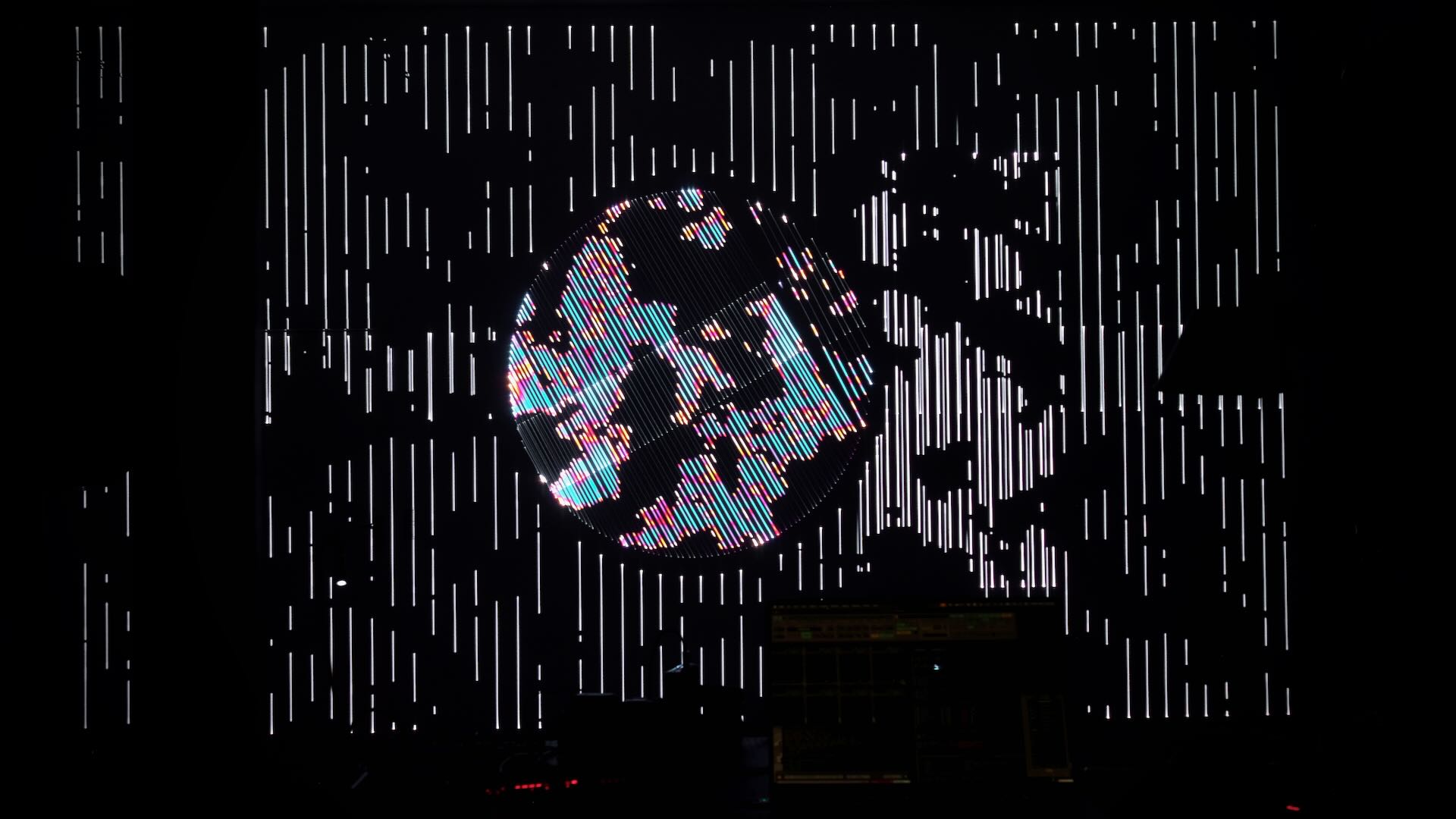 [rehearsal, September 2026]
Don't be arbitrary!
TF: You wrote a text about the abundance of tools, the nearly infinite technical options available for creative work, and limitations as a way out of getting lost. Your last big concert piece CBM 8032 AV obviously embraced an idea of limitation, being based on obsolete computers from 1980. How does FIRST LIGHT fit into this? How do you avoid being arbitrary?
RH: Do I? At least I hope so! FIRST LIGHT is also about limitations. I do graphics with lasers, and that's pretty archaic - a very narrow focused beam of light, drawing shapes on a screen by precisely moving mechanical mirrors. This imposes a lot of limits on the potential complexity of the results.
A lot of my work is concerned with finding things that look complex and interesting whilst being simple enough to be drawn with my lasers. That inevitably creates an aesthetics of its own, which I harvest.
TF: Can it be too much? Is there such a thing as 'too much' in your art? I think about minimalism versus abundance here.
RH: Absolutely! Most of the time I listen to old music of mine, my first thought is:
I should have removed this or that element! I grew up with limited access to technology and hence when being able to buy studio gear to produce music I had a tendency to just add layers on top of layers.
Nowadays, a few decades later, I can be much more relaxed and I try to strip things down.
Working with the CBM 8032 AV project taught me a lot in that regard. If you only have three monophonic voices and two effects, the perspective on composition changes quite radically.
I don't know yet how this will work out with FIRST LIGHT. I try to find a good balance between meaningful complexity and reduction.
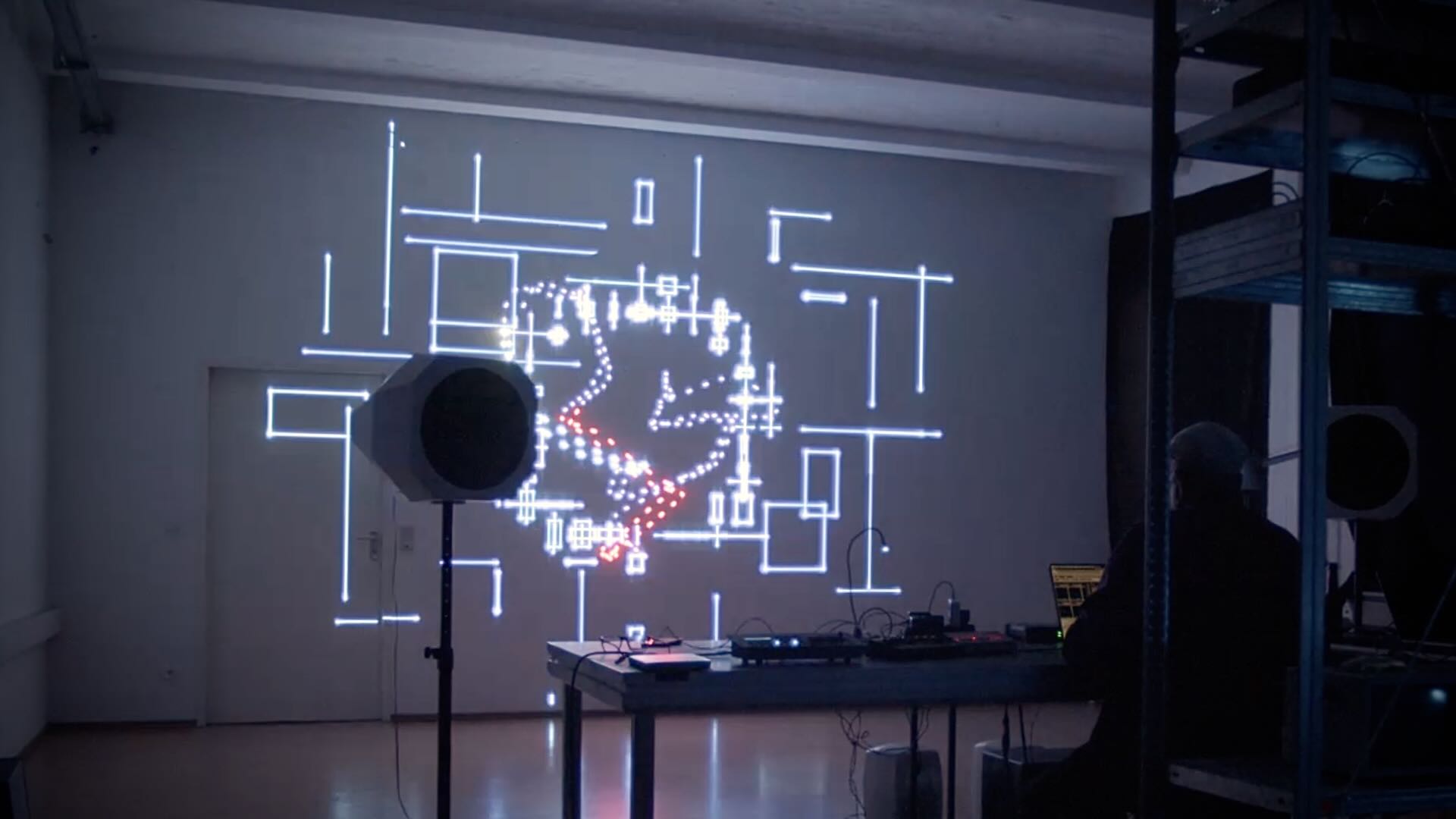 [rehearsal, September 2026]
The big arc
TF: I found two things remarkable with your CBM 8032 AV performance. First, that something as nerdy and technical as 8-bit computers on stage can produce such emotional results, and second how much you seem to care about the overall structure of your piece. I'd like to focus on the second one: Taking care of a big arc in a composition seems to be quite an outdated concept in the age of Instagram and TikTok where only the moment matters. Why bother?
RH: I care, and that's enough. Ultimately I need to be happy with what I am doing, and some of my most satisfying experiences in music - or any other time-based art form - had to do with the mastery of pace and time.
Well structured time turns 'great moments' into one single fantastic journey. I spend a lot of time organising time (laughing). When a CBM 8032 AV show comes to its finale, everyone in the audience can feel that this is the end of the arc, and that's so satisfying.
I hope that I can achieve a similar experience with FIRST LIGHT. Like a great symphony where you are listening to the last five minutes and you think: oh, shit what a ride. And then it lands and you are just sitting there in awe. Like: what.the.hell.was.this?!!?
TF: What's that big arc in FIRST LIGHT? Will you give an introduction speech like you do for CBM 8032 AV?
RH: There will be most likely no speech. For CBM 8032 AV it was necessary to understand the context of work, but FIRST LIGHT should speak for itself. There is no 'big arc' in the story, it is a collection of shorter ideas, but of course the order is carefully chosen, and I believe I found a pretty cool ending.
I am spending a lot of time thinking about how to start, how to end? What points are pivotal and need to be placed carefully inside to make most sense? Those thoughts often also lead to painful decisions about throwing things out, which might be nice in itself but simply do not fit the overall flow.
TF: Tell me about the music. How is it related to what we see?
RH: The Lumière series was based on 'atomic' audiovisual composition: A sound and a simple visual shape are combined to form a unit, and multiple of these units are sequenced in time. The power came from the simplicity and directness of each element.
For FIRST LIGHT, I use a different approach: For every piece I build an intricate and complex 'visual machine' which is supposed to be interesting to observe for longer periods. The behaviour is gestural, and I try to find music that supports the mood and the gestural nature of those machines. From that point onwards, there is a co-evolution. I want a specific element in the music to be present, and I try to find a way to justify this visually, or there is a potentially interesting visual development which would highly benefit from a matching musical gesture. And all pieces themselves are held together by an overall narrative.
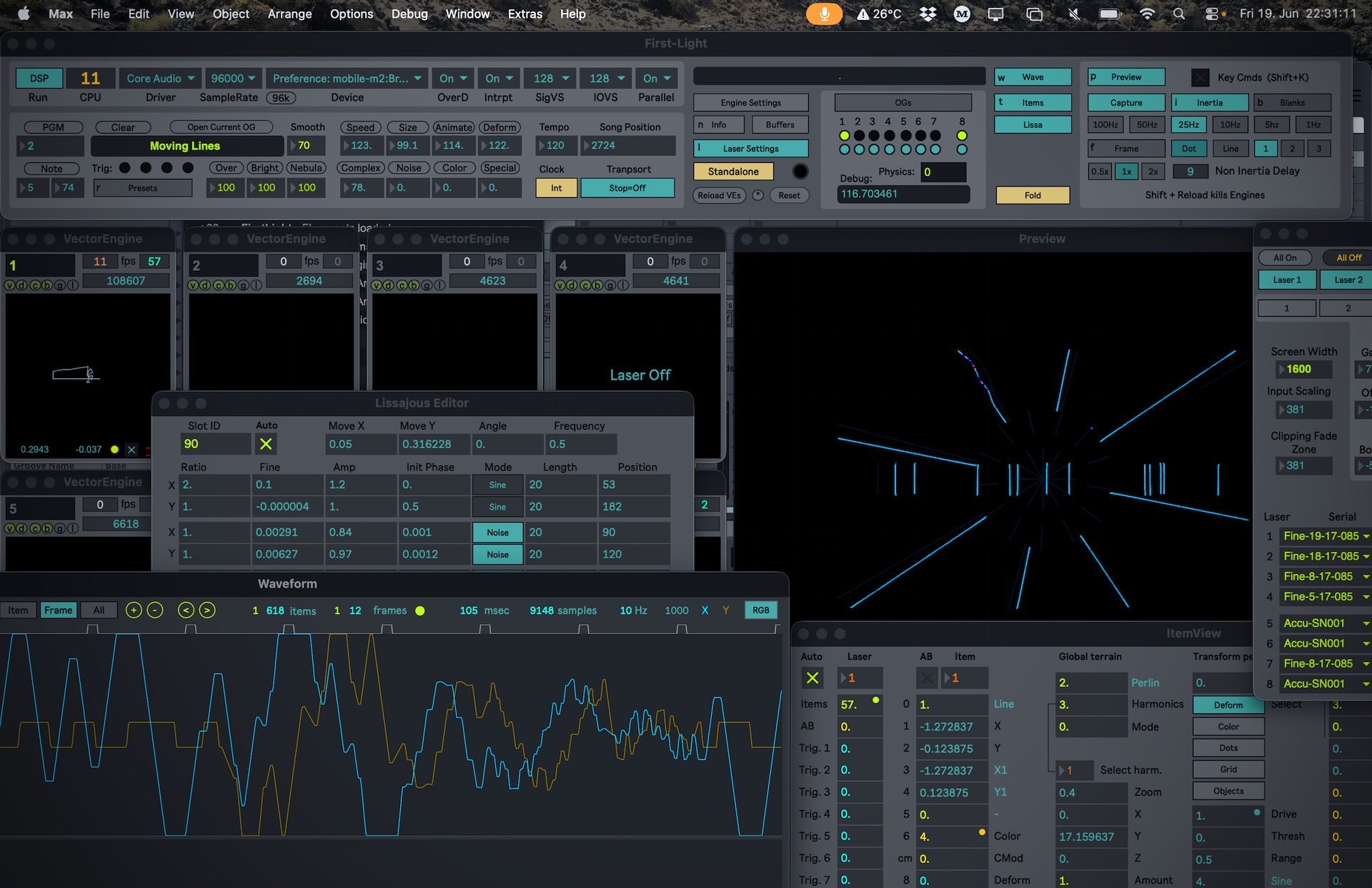 [Screenshot of the FITST LIGHT ENGINE, the Max patch driving the laser graphics]
Continuous work in progress
TF: FIRST LIGHT is your second large-scale laser concert piece after the Lumière series, which you started almost fifteen years ago. What is different?
RH: As you know I am fascinated by the history of technological progress, in a sense that it tells us about human capabilities to reach new frontiers.
Like how we learned to build a transistor, and then how to put several of them on a chip, and then using computers built with these chips to design more complex chips with millions and now billions of transistors which now enable technologies like large language models.
Every emerging new technology is the result of a deep understanding of the current state and using that knowledge as a basis for the next step. For Lumière I harnessed the drawing of simple geometric shapes, highly synchronised to incoming musical note events. It was all about that simple and direct interaction.
I spent a lot of time during the last four years building a completely new laser graphics engine, which incorporates all that knowledge, but it adds a new layer:
It is not about the atomic shapes anymore, it is about controlling a lot of them to create far more complex behaviours. It is still based on simple, abstract objects; lines, dots, circles, etc. But what you experience is movement, mass, architecture, forces. I surpassed the 'single transistor' level and now I am building my first integrated circuits. This is really exciting.
But what it means to me is beyond the technical achievement, it means I can tell stories in a different way, I can find abstractions for bigger topics; birth, evolution, expansion, transformation, conflict. And all that with just a few beams of light and instrumental music.
TF: You wrote on your website that FIRST LIGHT 'will always remain work in progress'. What does this mean?
RH: It is an evolutionary work, where the idea of improving and exchanging parts over time is considered from the very beginning. Have you ever seen photos of one of these large scale scientific experiments that go on for decades? They are like cities; elements get replaced and rearranged whilst others need to remain functional, things grow within the possible limits of physical spaces, it is a fascinating mix between foundational parts which might be there since the inception and brand new ones that manifest the latest upgrade.
Ideally FIRST LIGHT develops the same way, over a hopefully long and fruitful life cycle. I don't know yet if everything I composed and coded will have the impact I want to achieve, and I don't know what kind of ideas I come up with whilst performing. I want to deliberately embrace that instead of worrying too much about it 'not being finished' for the premiere. Live means change. Whatever is static is dead already.
 [rehearsal, September 2026]
Fighting the demons
TF: Do you often have doubts about your work and how do you deal with it?
RH: I don't know any artist who is free of doubts. It is the nature of art that it has no direct measurable use.
When I write a piece of code, I define beforehand what it is supposed to do and I can evaluate the result based on that. This is also why I really like doing it. The goal and sense of achievement is so clear.
With art, it is much harder to define valid criteria, everything can make sense somehow. But some combinations, some results are just magic, and it is nearly impossible to pin down why. You feel it when it is there. In retrospect it seems it is the only possible way the work could be made.
But before you arrive at this point, nothing is clear and it could have gone in a completely different direction. How to deal with that uncertainty? Doing it, again and again, and learning to accept that everything is an experiment, with the option of failure. But if you don't allow yourself to fail to a certain degree, nothing new can happen.
As far as FIRST LIGHT is concerned, I had to fight a lot of anxieties. It is the 'next big thing' after CBM 8032 AV. Which so far is the biggest singular artistic achievement of mine, the most complete, unique work. Now, six years later, FIRST LIGHT should ideally have a similar impact and quality. We are 10 weeks away from the premiere and I feel things start to come together nicely.
There is still an enormous amount of work to done, but I really know what to do and in which order.
The premiere is not the end point, not at all. It is the beginning of hopefully a long evolution.
CBM 8032 AV changed a lot in the last five years, I learned how to 'really' play it, I improved some technical aspects, I replaced a visual piece, I changed some compositions and so on. It is a much better work than it was at the beginning. In that regard, the premiere just needs to be good enough to give an idea about the future. I am not doing cinema. This is permanent work in progress, a living thing, performed and mutating of the next years to come, hopefully. For FIRST LIGHT this is definitely the path I aim for.
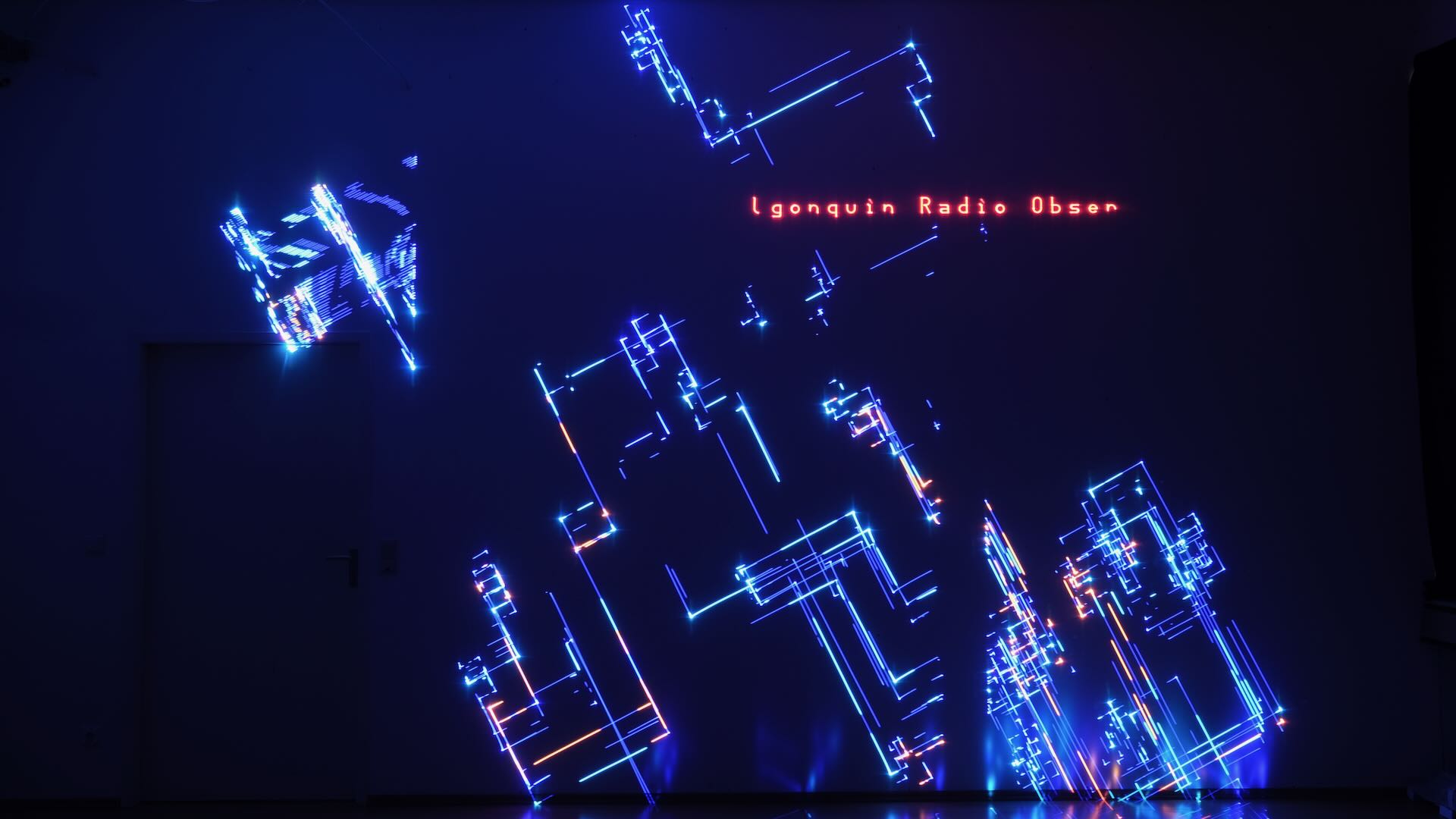 [reharsal photo, September 2026]
Art, Politics and Science
TF: FIRST LIGHT is dedicated to women in science, especially in astronomy, space exploration, and related fields. Why?
RH: When I started working on my new laser piece, even before it had its final name, I was looking for a way to connect it to something outside my computer screen, something that has a meaning for me.
I gravitated towards astronomy and started reading up on it. And I stumbled across the fact that Jocelyn Bell Burnell never got a Nobel Prize for her discovery of pulsars. Lise Meitner also never got the recognition she deserved. If you open a random book about particle- or astro-physics from thirty years ago, there are only photos of men. Yet so much essential work has been carried out by women. The more I did dive into this, the more it became obvious. And hence the dedication. I wrote more about it on my website, on the FIRST LIGHT page.
TF: Do you believe art is political? Especially that type of art you are doing, which seems to share a lot of properties with those inoffensive mass entertainment events of 'immersive' AV art. Do you have a message? Do you care?
RH: Of course art can be highly political. And yes, I do care a lot.
The artist is in theory in a privileged position: We are free to share our opinions, to engage in a dialogue, we are not bound to any company policy that might inhibit our voices. But, as we learned in recent years, this liberty is fragile and nothing to take for granted. I don't think there is a obligation for artists to deliberately position themselves, but often enough opportunities arise where we have a choice, and where our decissions and actions matter.
But I want to focus on something more specific. As 'digital artists' we are by nature close to the computer industry, and to a quasi-religious believe in the merits of technological progress.
I spent a lot of time reading up on the history of computer technology, I had the privilege to teach at Stanford University, and got some first hand impression about the mindset of those who shape our technological world.
That world always had a dark, ruthless side, driven by strong egos, which is very far away from that public image of 'don't be evil'. But more recently that dark side got a lot more powerful.
It is pretty hard not to feel doomed, considering that more and more of our vital infrastructure world wide is operated by explicitly anti-democratic, ultra right-wring and ultimately deeply inhumane and cynical people with infinite financial resources, way above what any government has available. That was one reason why I was hesitant to jump on the NFT wagon and on crypto currencies.
Those people also share a strong believe that governments are bad and the world would be a better place if run by some selected CEOs - by them.
As much as I enjoy technology, I simply cannot embrace that mindset, and perhaps I am just lucky that I never got offered enough money for a commission by some of those companies. I once was asked to be part of a group exhibition whose main sponsor was Palantir. I strongly rejected the offer and it was pretty shocking for me to realise that most other artists did not care at all. Ultimately the thing did not happen, but the curator afterwards never asked me again to do something with him.
To sum it up: My art itself has not much of a political message, but I hope that my actions as artist radiate a view of the world that makes sense as role model.
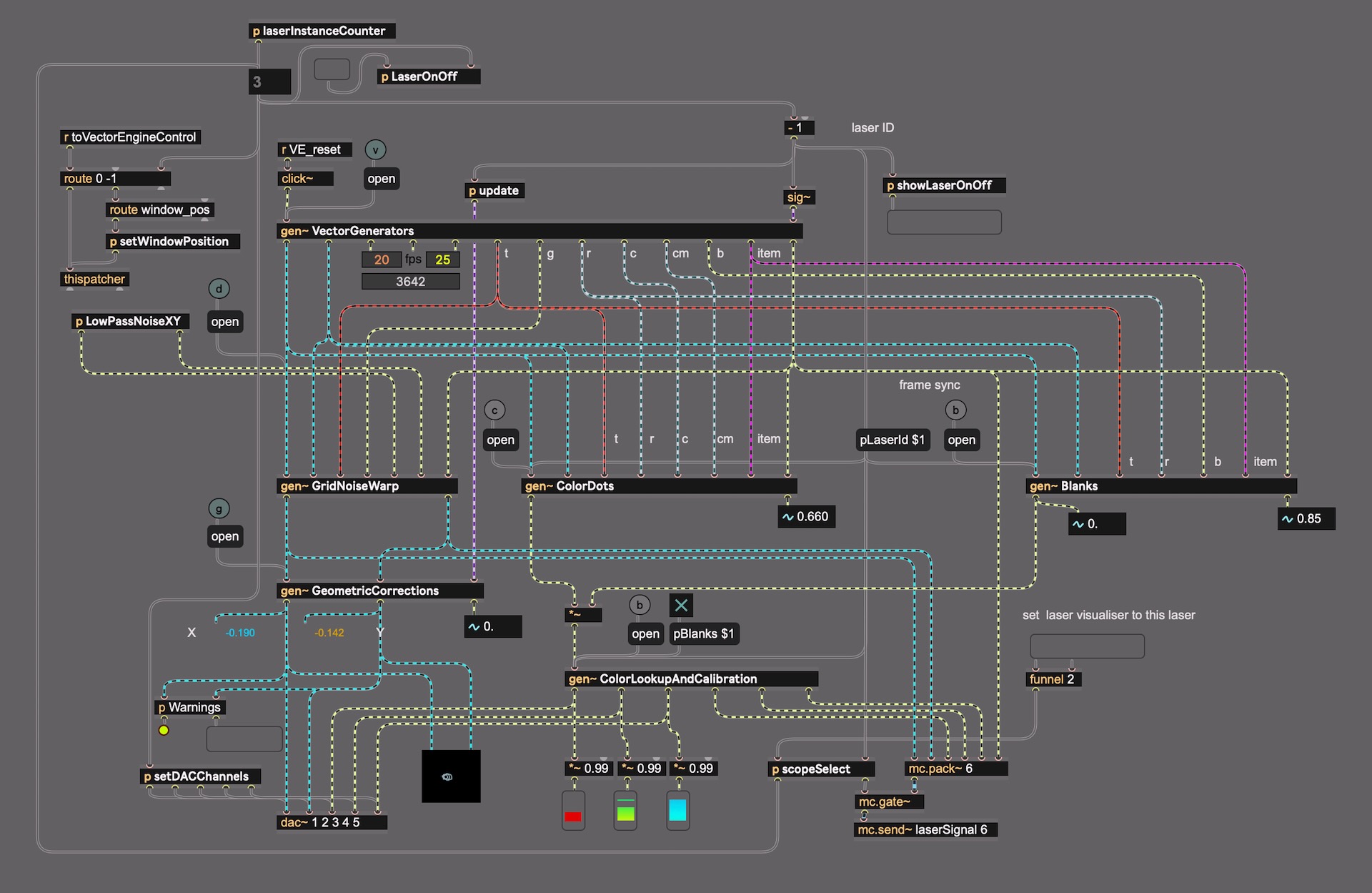 [detail of part of the MaxMSP structure driving FIRST LIGHT]
Writing Code
TF: This question has to be asked in 2026: What is your stance on AI in music?
RH: I have to admit that I underestimated the impact of AI.
I did not spend much time exploring it for direct musical creation. At the moment, I really don't care about writing a prompt to get a result that is a machine generated mash-up of stolen ideas. I still like to move notes around in a grid and patch cables in my studio - old school! (laughing).
But. Coding... !!!
When computers were invented, the only way to program was to understand exactly how the hardware was working, and directly interface with each unique machine to tell it what to do.
With the advent of 'high level' programming languages like BASIC, FORTRAN or C++, it became possible to write software with only a limited knowledge of the underlying hardware.
The transfer between the abstract concept of "a = sqrt(b)" and what the computer had to do to get the result has been taken care of by some software, the interpreter or compiler.
The impact was huge: Not only could people start writing software who had no deep understanding of the details of the hardware, but also programming became much faster, and the complexity of possible results exploded.
And now we are at a similar step. We only need to be able to provide a meaningful description of what we want to be done, and some 'agents' are capable of turning this into code.
The job of the software developer is fundamentally changing. And the impact on the development of my FIRST LIGHT ENGINE, the underlying software enabling me to do my laser graphics, is huge. I still write most of the code by hand and I understand every single line of it, but the speed at which I can add new things or find bugs in existing code multiplied.
When I started working with Claude, I treated it? them? like an intern: I thought which of the things they are good at, which are the most urgent tasks and so on. But after a while I realised that 'time' does not matter anymore. And I started to let it prototype ideas that would have been too complex to do for an intern. I replaced the intern with ten highly skilled developers who work non-stop. At less cost than the intern. And that's the revolution happening now, with all the consequences this will bring.
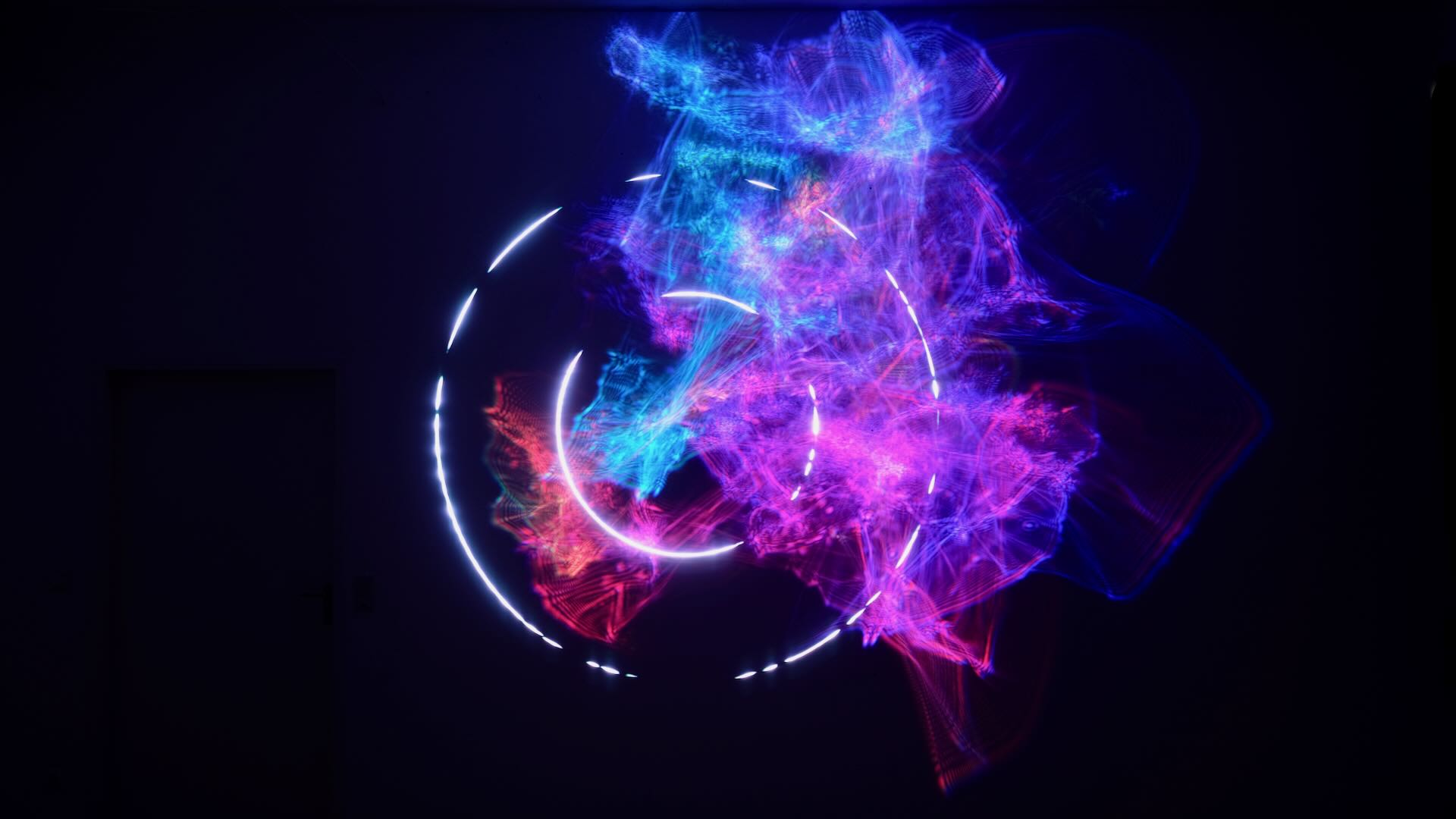 [reharsal photo, September 2026]
Teamwork
TF: FIRST LIGHT is obviously a complex piece, and you worked on it for three years...
RH: Four!!!...
TF: ... and I'd like to know more about 'teamwork'. I saw some credits on your webpage.
RH: I find this important. In books, there is often a chapter at the end, written by the author in which they credit all the people which were involved in one way or the other. And when you read it you start to understand what giant undertaking it was. And the same applies to large-scale audiovisual works. I could not manage a project like FIRST LIGHT all by myself. Technically I could, but there are two essential factors that matter a lot: time and motivation.
In order to finish the project some things simply have to be outsourced to create room for the tasks I absolutely have to do by myself.
I am incredibly happy that I am working with Jonas Margraf on the visual side of things. He is using my framework to develop the visual routines for some of the pieces, and seeing what he can do with the tools I wrote is so rewarding. He does things I never thought would be possible. This not only saves me time, but it also keeps me motivated to move on with my own works.
My laser graphics engine is based on a software tool called MaxMSP, and I pretty much push it to its limits with this project. As a result, I more than once ran into situations where I got stuck because of bugs in MaxMSP. Joshua Kit Clayton, an old friend of mine and one of the key developers of MaxMSP, did a fantastic job in fixing those in no time, allowing me to move on.
On the musical side, my wife Susanne Kirchmayr, who's a DJ and music producer herself [Electric Indigo] provided extremely helpful feedback. And then there is Michael Sollinger, whose company [LaserAnimation Sollinger] developed the lasers I am using, and who always has practical advice when it comes to laser related topics. Without those people my work would not exist.
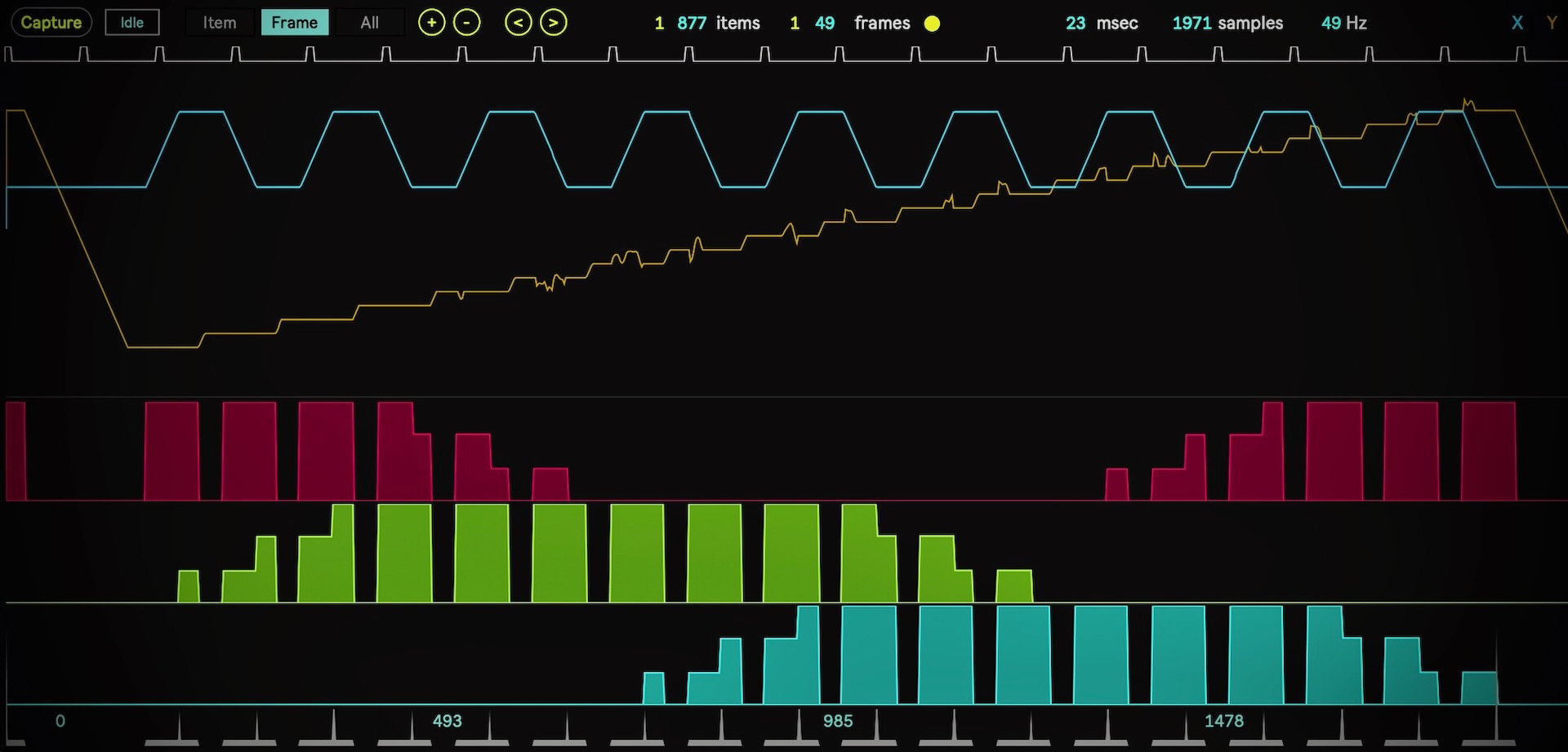 [laser scanner data analysis window in FIRST LIGHT ENGINE]
Relevance and Kitsch
TF: Is your work relevant?
RH: For me, absolutely. It is a big part of my life. For the world? Depends. I owe my own personal development, as a human being and as an artist, to a lot of external influences and experiences. There might be others for whom my work is relevant enough to shift their idea about what they should do themselves. If so, my work is relevant to them. But if anyone will care about what I did in two hundred years from now, I am not so sure. But since I will be dead by that time, I don't bother that much (laughing).
TF: What criteria do you apply to your art - or to art in general? How do you evaluate quality? Or do you just follow your instincts?
RH: Consistency is extremely important. So much music out there feels arbitrary to me, and prompt-based AI generated results perfectly fit that notion. What I value in art is the feeling of witnessing an intention, something that has a decisive color, shape, meaningful progression in time and space. When working on 'CBM 8032 AV' this was easy - the medium is so limited, it superimposes its own gestalt. There the challenge was to transform complex ideas into something a bunch of 45-year-old computers can handle.
When composing with my laptop the situation is very different. Everything is possible in no time. The modus operandi for the music of FIRST LIGHT is subtractive: I create a lot of ideas and sketches, and then remove everything that I find unfitting, based on criteria either connected to the work itself, or to my Œuvre as a whole, or to what exists outside.
I had a glissando theme in one part that I had to remove because it felt 'too Vangelis' to me. I really liked it musically, but I wanted to avoid that the most dominant association with the piece is 'Blade Runner'.
TF: From the things I saw at the rehearsal, here is my impression of the music: It is obviously you - very 'Monolake-ish' - and it feels cinematic with its big dramatic textures and drums. Are you concerned about it becoming too much 'kitsch'?
RH: Yes. But more than of kitsch, I am afraid of that notion of arbitrariness.
That is for me the ultimate defeat. Because creating 'something' at a level that once was a skill became pointless with AI music tools.
The thing that still matters, or maybe even more, is intention:
Is the result recognisable 'me'? Does it take you by the hand for 90 minutes, guide you into another world and bring you back home safely? Is there some sort of meaning, however abstract, behind all that? On a compositional level, I try to find a balance between my desire to evoke feelings and the equally strong desire to avoid some of the most obvious triggers. The parts that shine do so even more when embedded in darkness. Like one of those dark renaissance paintings where you wonder how oil on canvas can be so vivid and bright.
TF: In two months is the premiere of FIRST LIGHT. What are you working on right now? Are you confident with the progress? What worries you? Will you be finished in time?
RH: I try to get as much as possible done, but it is clear that I have to make some compromises. Not every piece might be as advanced as I am hoping for, and I might not be able to work much on the surround sound mix, but this is why this is 'always work in progress' and hence I will be finished with an initial version. I am mildly optimistic. We should talk again after the premiere!
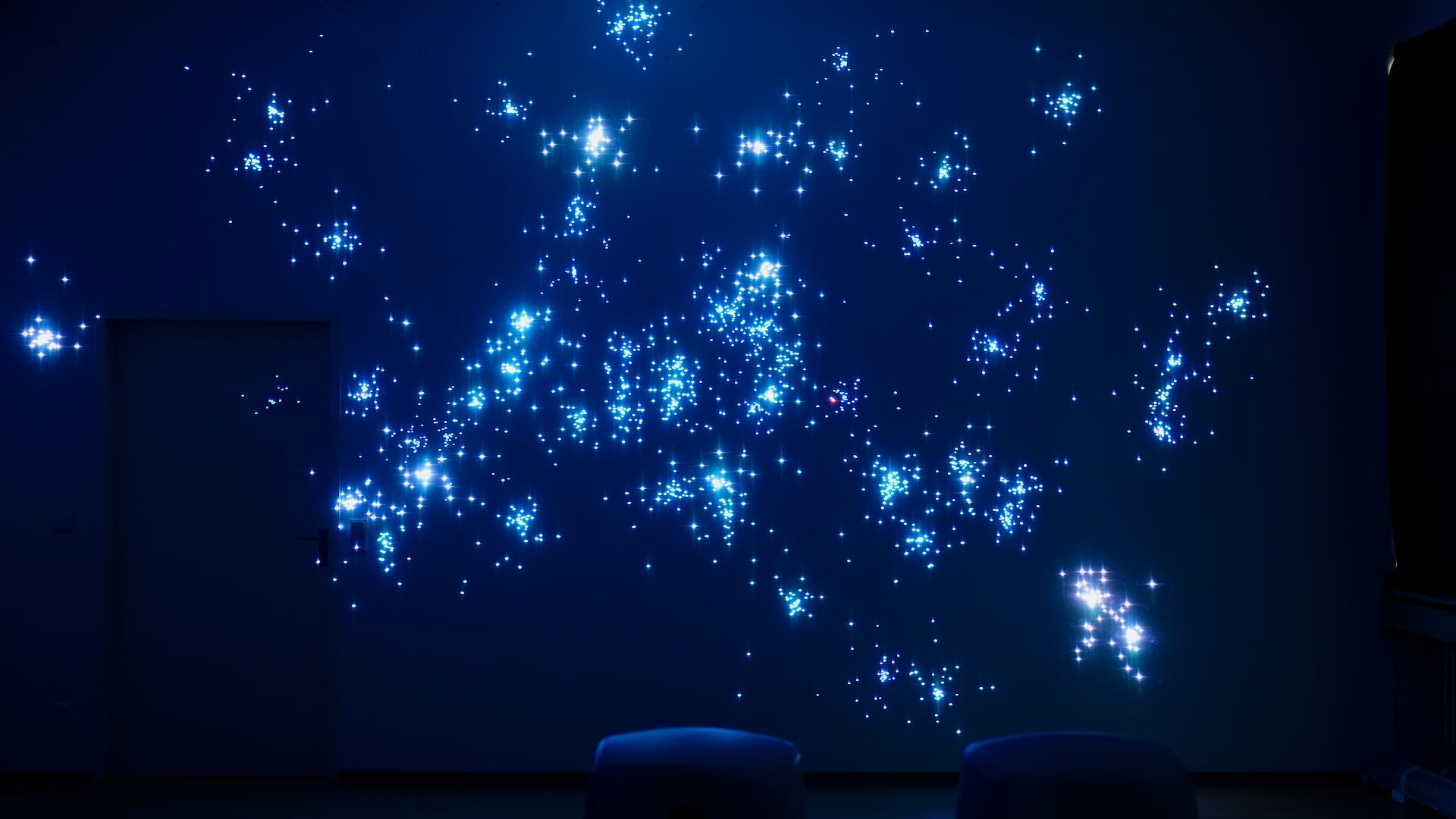 [reharsal photo, September 2026]