The Hitchhiker’s Guide to Live Performance in the Age of Supercomputers
Nine rules for survival on stage [2009/2025]

This text from 2009 sums up practical thoughts concerning live performance practice in electronic music. Slightly rewritten and extended in December 2025
What Is a Good Performance?
If what we deliver as performers shall be perceived as good, we first need to find out what that highly subjective notion of good could stand for. 'Good' can mean very different things for people, depending on their point of view.
Let’s approach it from the outside first. What could an audience like? A typical club or festival audience usually consists of some people who are familiar with the work of the artist, and some who are not.
The first group hopefully also consists of many fans, who are explicitly there to experience the artist and their work. If the music and the situation support it, some might want to dance, while others might prefer serious listening. And some members of the audience might be musicians themselves and judge music from a more informed perspective than the rest of the crowd.
Such a diverse group naturally has diverse ideas about what is perceived as good. We know that this is the case if we simply ask our best friends how they liked a specific performance they saw recently and end up in a long discussion.
The Fans
Fans have a high familiarity with the work of the artist. Sometimes they know more about the music than the artist themselves. [Did you ever experience that someone provides an in-depth analysis of one of your works that by far exceeds any thoughts you deliberately put into the work when doing it and yet totally makes sense?!] They have the whole release history in mind, they were at the last five concerts, and they read all the interviews.
This is both a chance and a risk. Fans can be ultra-euphoric, but they are also the group of people who can become most upset if they think what the artist delivers is not good. [Unrequested advice: Do not read online forums discussing your work]
The fans know the works of the artist inside out, and they can recognise the songs when performed. Since we assume they are our fans because they like our songs, we could come to the conclusion that playing music they know is a good thing. Great! Let’s define the first rule for a successful performance:
(1) Play stuff the audience knows
Nothing can go wrong with that. The only way to make it even better is by applying another obvious recipe:
(2) Only play hits
You probably know which of your songs people like most, so simply play those and not the other rubbish you put on your last album to fill up 60 minutes. Now we are going to add all possible ingredients to the scenario above to make it perfect: the music is played by a band of skilled musicians and not just run from a laptop, the light is great, the sound is great. Isn’t it great how great it all is?
Does such a performance deserve that a drunken person shouts out loud, “boooooooring!!!!”?
Well… yes. Because besides all the effort that might have been undertaken to recreate the best-of collection on stage, the result is less exciting than what any average DJ could do with your work.
The DJ would not just play song after song; they would mix it, enrich it with other people’s material, put it into a new context, and create a new flow. And by applying DJ wizardry, they would create something new and exciting.
The performer who reproduces their work on stage in perfect studio sound does not create anything that goes beyond the expectation of the audience. What they do becomes totally obvious after the first few songs. And boring indeed—at least for the fans or other folks who care.
People who are not familiar with the artist’s work will not recognize this, but everyone will feel the lack of a certain euphoric empathy that can only come from those who know, and whom the performer needs to have on their side. If you are a band, there is still a chance that people appreciate the technical skill set of the musicians.
But if you sit behind your laptop and it sounds exactly like on a record, most people will assume that what’s happening right in front of them is the playback of a mixed track.
What the informed audience wants is something else, something unexpected, something that grabs their attention. This leads to the third rule:
(3) Surprise your audience
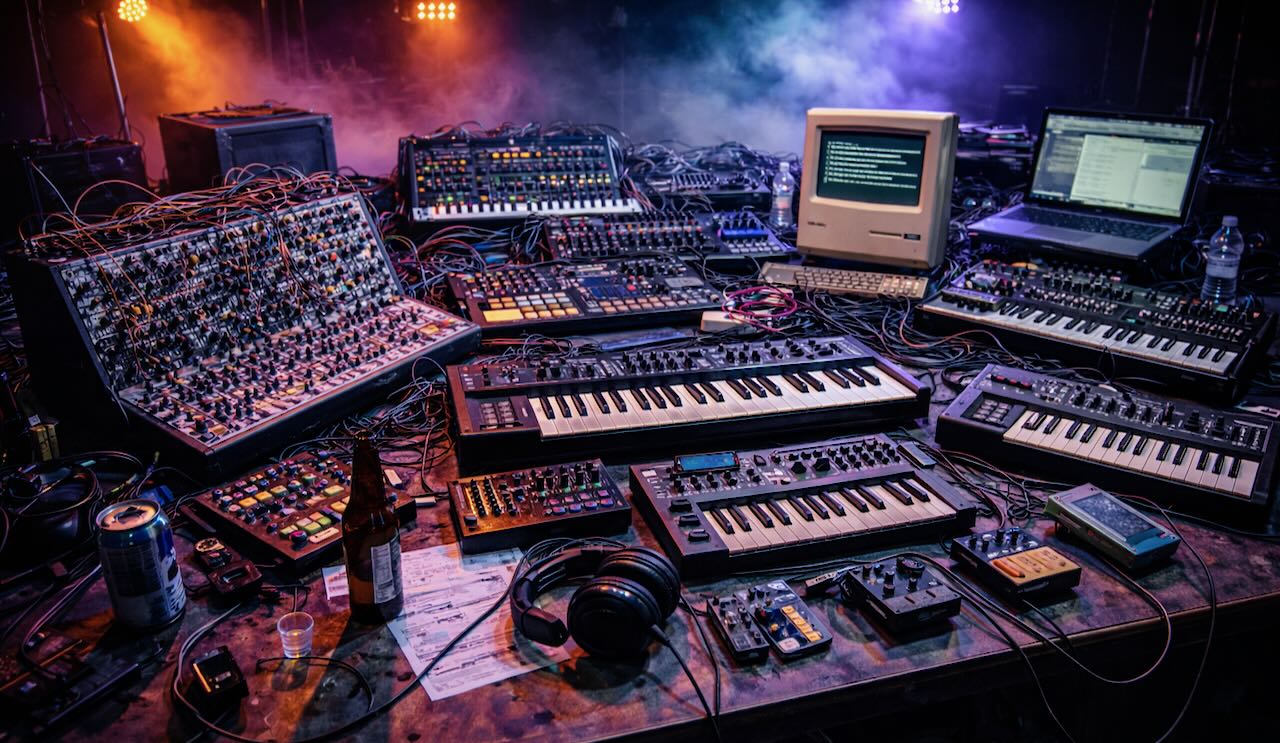
'Photo' above shows a typical stage setup of electronic music according to a certain LLM image generator
Not every surprise is a good one. A computer crash on stage is quite a massive surprise, but it is unlikely that the performance benefits from it. I say unlikely, and not impossible, because I once managed to turn a crash successfully into stand-up comedy. But in general, the surprise should be on the side of the audience.
A while ago I had incredible joy of experiencing Steve Reich’s piece Drumming performed in Berlin. I knew the piece, but hearing it live was totally mind-blowing. I did not expect it to be such a different experience in comparison with the recording.
The piece was performed at the Kammermusiksaal of the Philharmonie. That space is a beautiful jewel of architecture; it radiates calmness, focus, and openness. You enter the foyer and feel anticipation.
And once you are finally seated inside the concert hall itself, the outside world is gone and all your senses focus on what you are about to experience next. This is obviously a great starting point for both the audience and the performer. It is a place that creates and provides the conditions for a good performance.
Hence we can state a new rule:
(4) Choose a great space
The first thing to notice that evening was the arrangement of the instruments on stage: a large row of bongos in the front, three marimbas, and three glockenspiels, all arranged nicely on the empty stage; some chairs on the left and right side of the stage for the musicians; and next to the chairs, on the floor, on a piece of black fabric, the mallets.
Even without knowing anything about the piece that would be performed, the stage already told a story.
During the concert, the musicians either played their parts or went back to their chairs. This little bit of well-choreographed stage performance underlined the fact that Steve Reich’s music is highly structured.
The music is defined by its score, and the score becomes visible through the number and placement of people performing. Everything during the performance, including that little ballet of musicians getting up, playing, and sitting down again, was about focus, structure, and attention to detail.
Also worth noticing was the fact that while all musicians were dressed in a very formal and classical-music-audience-compatible style, they all had slightly differently coloured shirts that set them apart from a more conservative orchestra and can certainly be read as a statement in such a context.
I examine this in detail here because I strongly believe that it is important to pay attention to details like how the stage looks, how our equipment is placed there, how we look, how we move on stage, and all those things. They have nothing to do with the music directly, but they shape how the music will be perceived:
(5) The performance is not just about the music
The piece Drumming starts with a single instrumentalist playing bongos with a mallet. During the first few minutes, I was almost shocked, confused, and disappointed.
I had a seat very far away from the stage, and concert halls like that are not built primarily for percussive short signals emitted from a drum.
The reverb of the room dramatically changed the perception of the music, and what I was hearing did not have much in common with what I knew from the recording. However, the acoustics of that space worked very much in favour of the more complex parts of the piece, where all the overlapping percussion merged into a pulsating, breathing wall of sound of incredible beauty.
After all, that space was designed to make music sound great, and even though my seat was not perfect for listening to percussion, the overall sound was simply amazing.
What really made the concert such an overwhelming experience was how stunning the composition actually sounded. That overwhelming richness and sonic complexity was incredibly satisfying. Conclusion: if we love music, let’s make sure it sounds great.
(6) Make sure it sounds great
The topic of sound would deserve more than this article; it would need a book, or probably a whole bookshelf.
Most of the time, it’s simply a shame what goes on here, especially in electronic music performed in a club. [Addendum 2025: a lot improved here since this part of the text has been written in 2009!]
It does not make sense to play music so loud that 50% of the audience has to wear earplugs during the show. It is a bad idea that the person on stage - who has no idea how it sounds where the audience is located - is actually the person supposed to be in control of the sound for that audience.
It is not a good idea to drive every single part of the signal chain into total overload.
Most electronic music producers are not professional sound engineers with experience in stage sound. And not every PA rental tech who has to work at a festival is motivated to provide the best possible sound for music they do not care about. And as long as the audience is going to a place “to party” and the performer is just a provider for that party background, there is not much hope for change. [Addendum 2025: Hello AI generated music, this is your future...]
However, bad sound is an issue, it keeps the audience from listening carefully. Bad sound supports simple, and predictable music. Bad sound works against any attempt to provide detail and rich color. While volume can create some sense of massiveness and compensate for missing detail to some extent, one thing clearly becomes harder to achieve: emotional impact.
Here comes a radical advice:
(7) Perform where you can hear the PA
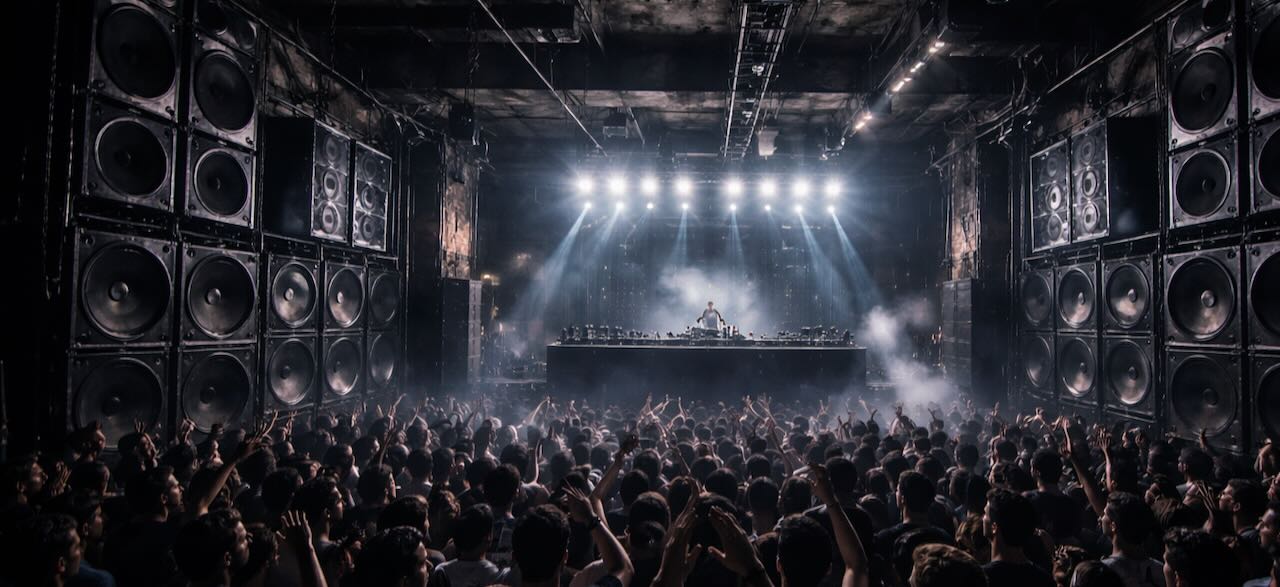
'Photo' above shows a european techno club with huge speakers, according to a certain LLM image generator. The cultural subtext here deserves its own text some day...
In spring 2008, I was invited to play at that year's BLOC party in the UK. I arrived at the venue: a big dance floor, a big stage, four impressive stacks of speakers, and an FOH ('Front of House' the position of the mixing desk of a concert in the middle of the audience) set up at the back of the dance floor, which happened to be quite central in that big room. When I arrived, another artist was performing. The sound on the dance floor was quite good.
I walked backstage, entered the stage to set up my equipment, and was totally frustrated by the fact that the sound on stage had absolutely nothing to do with the experience on the dance floor.
In a brave moment, I spontaneously decided that I wanted to play next to the FOH mixer and not on stage.
The organisers looked at me with a funny expression: a headliner who wants to play off stage at a 2,500-people event? I convinced them and played where I could actually hear (and 'play') with the PA, where I could shape every detail, every wave of bass, every single snare sound in a way that created the most impact on the dance floor.
And I was less than one meter away from the people, on their level. It was one of the best Monolake sets I ever did. I was in total control of the sound for the audience, and I performed 'together with them'. It. was. such. a. joy.
The best possible sound system only serves as a giant amplifier for every mixing mistake one makes as a result of the sound on stage not matching the sound of the PA. This is not an issue for a rock band, where the sound is created and controlled by the person behind the FOH mixer — a person who knows their job and understands what the band wants. But for more advanced electronic music, this often does not work so well.
Often there simply might be no person who takes care of that. If there is someone, their musical taste might not match yours, unless you have the luxury to travel with your own sound engineer.
The only person who can decide about it is you. But if on stage the sound is horrible anyway, performing with sound is like painting with color under an orange street lamp.
Electronic music is often more about shaping sound than playing melodies or chord progressions. Unless the FOH mixing engineer is really familiar with your style of music, they might have a wrong idea of how it is supposed to sound. And, to be fair, what is that person supposed to do when they already get a totally distorted and overloaded signal from us because anxiety made us playing much louder during the set than during soundcheck?
There is a reason why the most under-complex, most generic music often works best: a sound design that has been tested in thousands of clubs will most likely work in yet another club. However, this does not serve the evolution of music, and it is quite boring.
We know that a Roland TR-808 bass drum does the job in a club. Fine. Let’s find a less overused sound. How can we do so if we cannot hear it?
Club music could be far more advanced if the creators had more control over their work. However, this means investing time and effort into convincing promoters and PA technicians: How much time is there for sound check? How good is the monitoring on stage? And it might mean questioning the usual routine: Do I need to be on stage? Can I find a space in the middle of the room?
Experiencing a concert in a club or as part of a standing audience at a festival means moving your body, communicating with other people, and potentially enjoying a space very different from a home listening experience - along with many other factors that shift attention.
What might seem boring, too repetitive, or too reduced when listening in the studio might be exactly right for such a situation.
This does not only concern the music itself, but also the potential interaction with it when performing. How many aspects of a composition can be controlled in a meaningful way by the performer? This is one of the most crucial topics to think about when designing a performance.
Which elements of our music do we want to potentially alter, and how much of it can we realistically do?
For the first question, I have no answer and I struggle with it again and again when working on a new show. I like being able to control the structure of my pieces, but how much can I change in a way that enhances the experience instead of destroying the piece?
The question about the amount of things one can do on stage during a concert is easier to answer: always much less than one thinks one can do. This leads to another rule:
(8) Reduce
To make things more complicated, this might be exactly the wrong advice when performing in a situation where attention to the music is much more focused than usual.
Five minutes of minimal techno in a concert hall might feel very long unless there are many interesting, complex changes happening in detail, timbre, or structure.
The last rule is the most general one. And, of course, the most difficult:
(9) Be Brave
This is a more explicit version of the third rule, but with a different focus: this one is all about you. Assume that the audience is there to experience something remarkable with you, and created by you. Trust the promoter who invited you, and trust the audience to be curious about what you have to offer. If you want to try something new, present your work differently from how you released it, or make radical changes to it - do it!